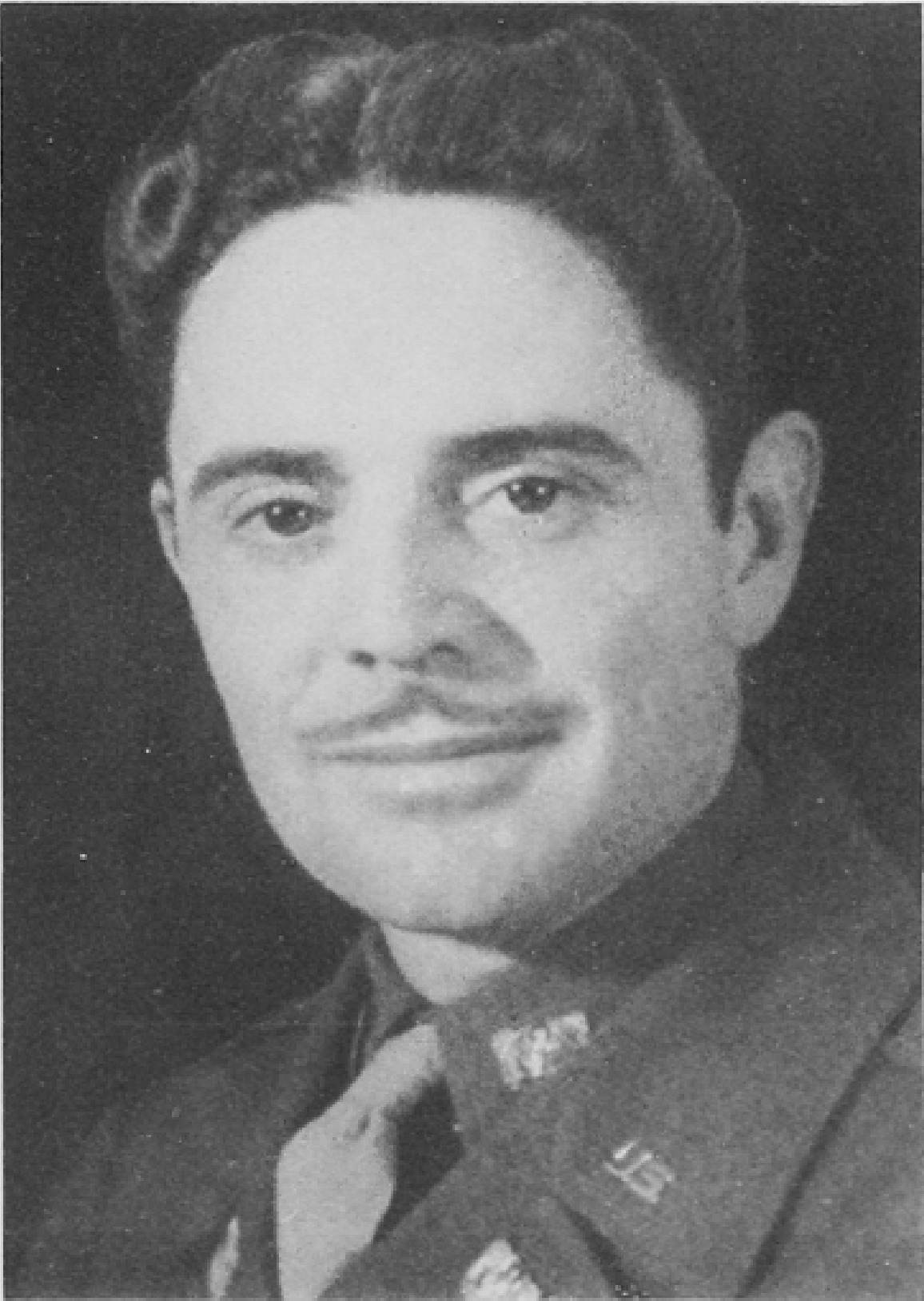
Portrait of Darrell Jefferson Cagle in uniform
A World War II Service Record

Darrell Jefferson Cagle

Chief Warrant Officer · 116th Signal Radio Intelligence Company
Army · Service no. 18 006 769
Service Number
18 006 769
Rank
Chief Warrant Officer
Final Unit
116th Signal Radio Intelligence Company
Theater
European Theater of Operations (ETO)
This timeline reconstructs Darrell's World War II service from his enlistment record and the Morning Reports, orders and unit records held by the National Archives, searched by service number. Each entry cites its source; items marked Newly discovered were recovered from the records.

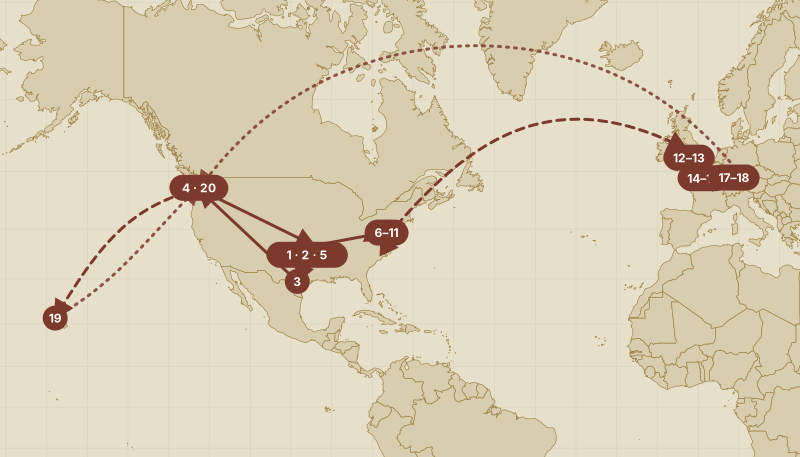
Map of Service

Route reconstructed from confirmed locations.

Map of Darrell Jefferson Cagle's documented WWII service route

Service stops

  1. Shawnee, Oklahomaborn 1911
  2. Dallas, Texasenlisted 8 Oct 1940
  3. Fort Sam Houston, Texas3rd Radio Intelligence Co., Nov 1940
  4. Fort Lewis, Washingtontransferred May 1941; 125th S.R.I. Co.
  5. Camp Crowder, Missouri116th activated 18 May 1942
  6. Fort DuPont, Delawarecompany station, May-Oct 1943
  7. Fort Dix, New Jerseydetachment, June-July 1943
  8. Elkins, West Virginiadetachment he led, Sep-Oct 1943
  9. A. P. Hill, Virginiafield training, Oct-Dec 1943
  10. Vint Hill Farms, VirginiaDec 1943 - Jan 1944
  11. New YorkCamp Shanks, then sailed 31 Jan 1944
  12. Liverpool, Englandlanded 11 Feb 1944
  13. Pylewell House, Englandarrived 13 Feb 1944
  14. Omaha Beach, Franceashore 9 Aug 1944
  15. Laval, FranceAug 1944
  16. Samogneux, Francenear Verdun, Sept 1944
  17. Bettembourg, Luxembourgwinter 1944-45
  18. Scheyern, Germanyfrom May 1945
  19. Fort Shafter, HawaiiArmy Security Agency Hawaii, ordered June 1954
  20. Retsil, Washingtondied 2003

Route notes

  • 1 → 2Living in Lamar County, Texas by 1940
  • 2 → 3Joined the 3rd Radio Intelligence Company
  • 3 → 4Transferred 9 May 1941
  • 4 → 5Cadre for the new 116th, May 1942
  • 5 → 6Company moved east, May 1943
  • 6 → 7Detachment to the 4th Motorized Division, June 1943
  • 7 → 8Back to Fort DuPont in July, then to the West Virginia Maneuver Area, 15 Sept 1943
  • 8 → 9Rejoined the company 21 Oct 1943
  • 9 → 10December 1943
  • 10 → 11To Camp Shanks and the port of embarkation
  • 11 → 12RMS Mauretania, 31 Jan - 11 Feb 1944
  • 12 → 13Southern England
  • 13 → 14Ashore 9 August 1944
  • 14 → 15Behind Third Army out of Normandy, 22 Aug 1944
  • 15 → 16Across France, September 1944
  • 16 → 17Autumn 1944
  • 17 → 18Through Belgium and Germany, Feb - May 1945
  • 18 → 4Home; ordered to the 60th Signal Service Company at Fort Lewis, Jan 1948
  • 4 → 19By way of Petaluma, California, to ASA Hawaii, June 1954
  • 19 → 20Retired 1959; Seattle; died at Retsil 2003
First time here?

How to read this service timeline

This page brings together records created for different purposes. The labels below tell you what kind of evidence supports each entry; open either guide when a record or military term is unfamiliar.

Confirmed — Service record

A personal military record supports the entry.

Confirmed — Unit record

A record created by his unit names him or documents the unit’s activity.

Context

Helpful background, clearly separated from personal evidence.

Newly discovered

Information recovered during this research, rather than supplied at the start.

How to read a Morning Report

Morning Reports were daily administrative records prepared by individual Army and Army Air Forces units. They generally recorded changes—such as arrivals, transfers, promotions, illness, or return to duty—not a complete list of everyone present.

MORNING REPORT · SAMPLE
1Organization
Company A, 123rd Infantry
2Station or location
Camp Example, Virginia
3Date
14 September 1944
4Section
Personnel changes
5Pvt Smith, John A., 35123456
6asgd fr Hq Co per SO 187, Hq 123d Inf
In plain English Private John A. Smith, identified by Army Serial Number 35123456, was assigned to Company A from Headquarters Company under Special Orders No. 187.
  1. 1Organization: the company, hospital, squadron, or other unit filing the report.
  2. 2Station or location: where that unit reported from on that date.
  3. 3Report date: the date of the report, which may differ from the effective date of a change.
  4. 4Section: the part of the form containing personnel changes or the unit’s record of events.
  5. 5Soldier entry: usually rank, name, and Army Serial Number.
  6. 6Change and authority: what happened and the order authorizing it.
asgd
assigned
atchd
attached
trfd
transferred
fr
from
aptd
appointed
EM
enlisted men
SO
Special Orders
GO
General Orders
orgn
organization
sta
station
Common military and research terms
Army Serial Number (ASN)
The unique service number used to distinguish one soldier from others with similar names.
Discharge or separation paper
The document issued when a service member left active service. For many WWII Army enlisted soldiers, this is WD AGO Form 53-55. It summarizes service but is not a day-by-day history.
Morning Report
An Army unit’s daily administrative report. It usually lists people whose status changed, not every person in the unit.
Unit record
A document created by a military organization. It may name the soldier directly or provide context about his unit; the timeline states which applies.
OMPF or “201 file”
The service member’s Official Military Personnel File. Many Army and Air Force files were damaged or destroyed in the 1973 National Personnel Records Center fire.
Unit and final unit
A unit is the organization in which someone served. The final unit is the organization shown at separation; it may not be the only unit in the service history.
Rank or grade
The service member’s level in the military hierarchy. A timeline may show changes in rank over time.
MOS
Military Occupational Specialty—the Army’s classification for a soldier’s primary military job.
Assigned and attached
Assigned means formally placed in a unit. Attached usually means serving with a unit temporarily while belonging administratively elsewhere.
Special Orders and General Orders
Official directives used to authorize personnel actions, awards, organizational changes, and other decisions.
Campaign credit
Official recognition for service connected with a named campaign. It does not, by itself, describe a service member’s individual actions.
Station or location
The place from which a unit filed a report. It does not automatically prove that every member was physically present there.
Source citation
The note beneath a timeline entry identifying the record or records that support it.
Service Timeline

28 min
Confirmed — Record
July 31, 1911

Born at Shawnee, Oklahoma

Darrell Jefferson Cagle is born in Shawnee, Pottawatomie County, Oklahoma, son of Harvey Cagle and Cora Annalee Rutledge. The family's memorials record five younger brothers and sisters. By 1940 he was living across the Red River in Lamar County, Texas.
Source: VA BIRLS death file (date of birth 31 July 1911); Social Security application (SS-5) index, NARA NUMIDENT, naming his parents and birthplace; obituary, The Sun (Bremerton, Washington), 11 July 2003; Find A Grave memorial #37497186
Confirmed — Service record
October 8, 1940

Enlists at Dallas as a Private of the Signal Corps

Fourteen months before Pearl Harbor, Cagle enlists at Dallas, Texas in the Regular Army for three years. He is twenty-nine, has two years of college behind him, and gives his home as Lamar County, Texas. His enlistment card carries the branch he would serve in right through the war: SC, for Signal Corps. The Army issues him serial number 18 006 769, the number this research began with.
Confirmed — Unit record
November 2, 1940

Joins the Third Radio Intelligence Company

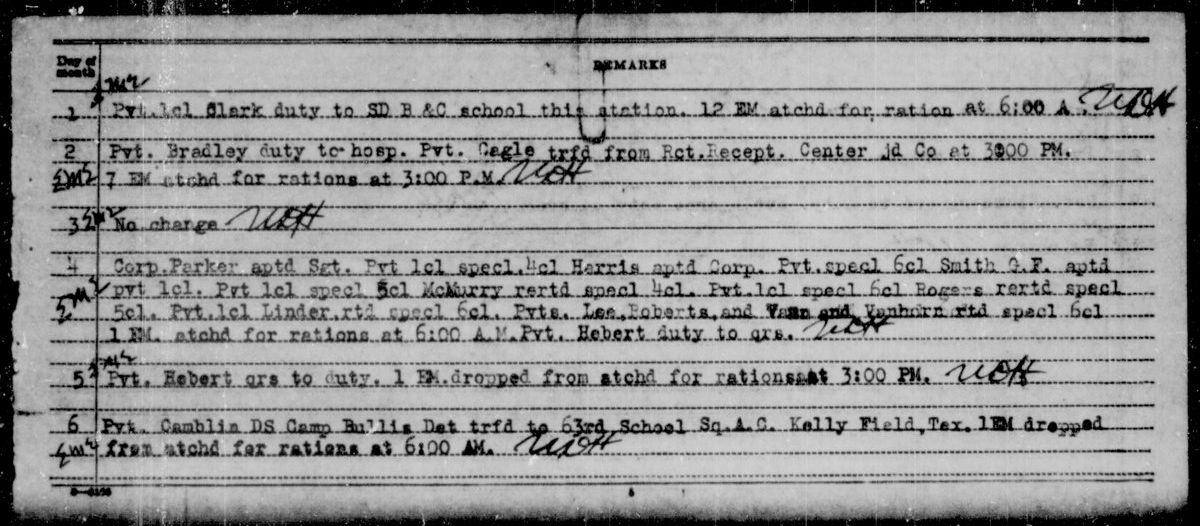
Twenty-five days after signing on at Dallas, a clerk of the Third Radio Intelligence Company at Fort Sam Houston, Texas writes in the day's Morning Report: “Pvt. Cagle trfd from Recept[ion] Center, jd co, 3:00 P.M.” This is the first of the three radio intelligence companies the 116th's own 1945 history names as his before he joined it, and the beginning of a career spent listening to other people's radios.

This page gives no service number. Three later pages of the same company close the gap. It sends Pvt. Cagle to the Signal Corps School, takes him back as a corporal, and in May 1941 transfers Corporal Cagle and Sergeant Barron to Fort Lewis. A year later the Fort Lewis report on this page lists Staff Sergeants Barron and Cagle leaving together for the 116th. The same two men moving together tie the Fort Sam Houston private to him. Newly discovered.
scanned record
“Pvt. Cagle trfd from Recept. Center, jd co, 3:00 P.M.” The yellow is ours — it marks his name and service number on the sheet.
scanned record
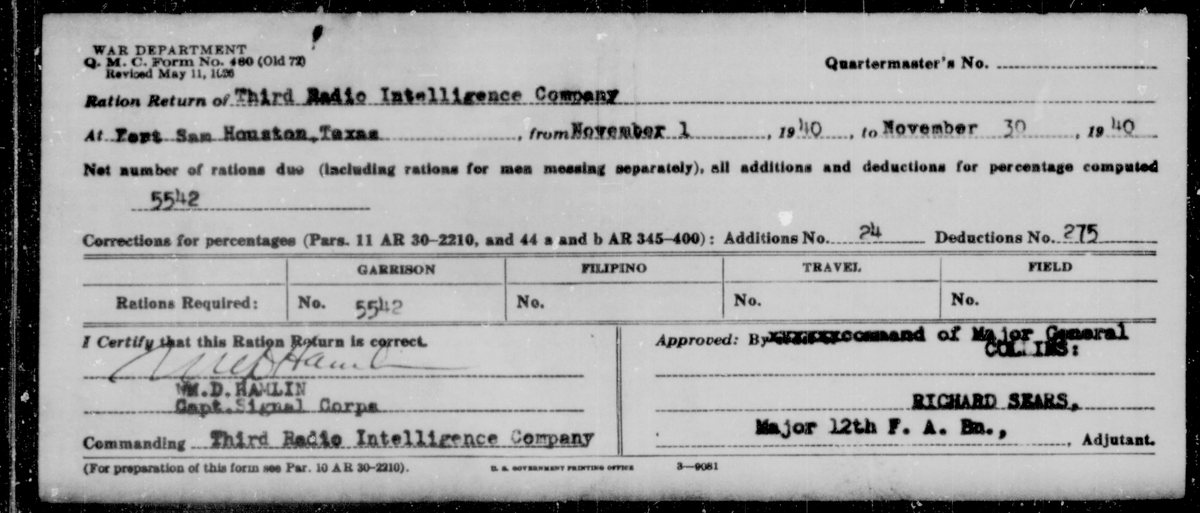
The ration return that dates and places the page: Third Radio Intelligence Company, Fort Sam Houston, Texas, November 1940.
Source: Morning Report — Third Radio Intelligence Company, Fort Sam Houston, Texas — NARA Roll 2581, image 2574 (NAID 440001084, 2 November 1940)
Confirmed — Unit record
December 18, 1940 – April 19, 1941

Four months at the Signal Corps School

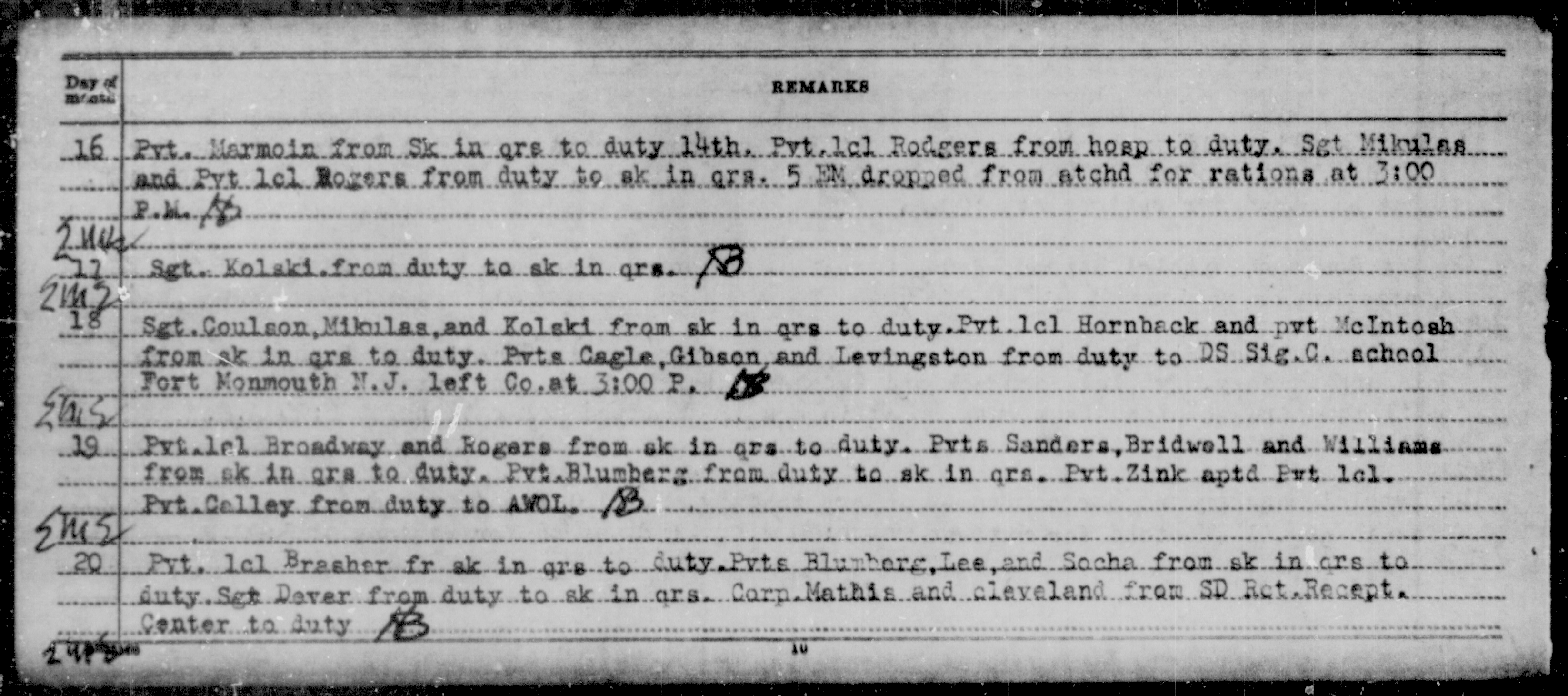
Six weeks after he joined, the company sends him east. Its report for 18 December 1940 reads: “Pvts Cagle, Gibson and Levingston from duty to DS Sig. C. school Fort Monmouth N.J. left Co. at 3:00 P.” Fort Monmouth, New Jersey, housed the Army's signal school. He comes back four months later with a promotion. The report for 19 April 1941: “Corp Cagle and Pvt Levingston DS Sig C Sch Fort Monmouth N.J. to duty at 5:00 A.M.” Newly discovered.
scanned record
18 December 1940: “Pvts Cagle, Gibson and Levingston from duty to DS Sig. C. school Fort Monmouth N.J.” The yellow is ours — it marks his name and service number on the sheet.
scanned record
19 April 1941: “Corp Cagle and Pvt Levingston DS Sig C Sch Fort Monmouth N.J. to duty.” The yellow is ours — it marks his name and service number on the sheet.
Source: Morning Reports, Third Radio Intelligence Company, Fort Sam Houston, Texas: NARA Roll 2581, image 2595 (December 1940) and image 2664 (April 1941), NAID 440001084
Confirmed — Unit record
May 9, 1941

Transferred to Fort Lewis

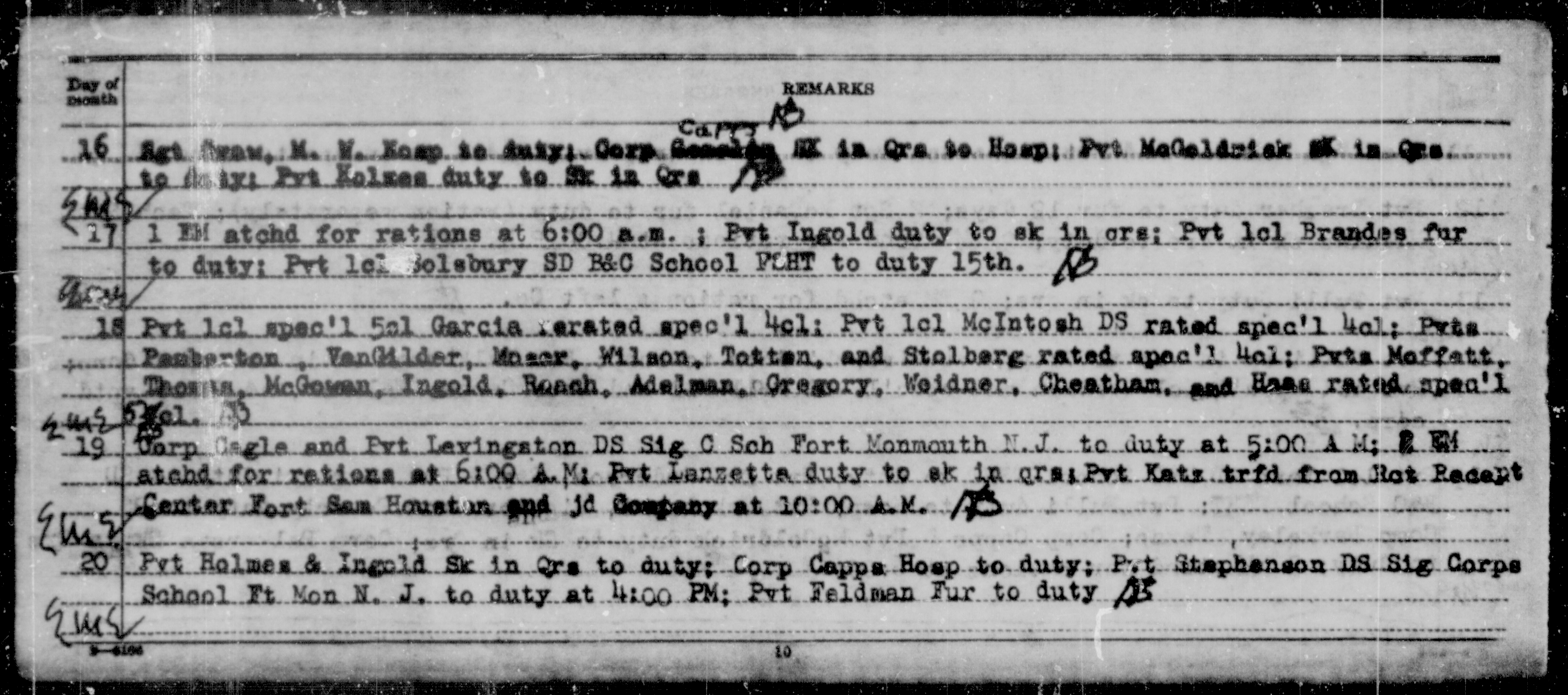
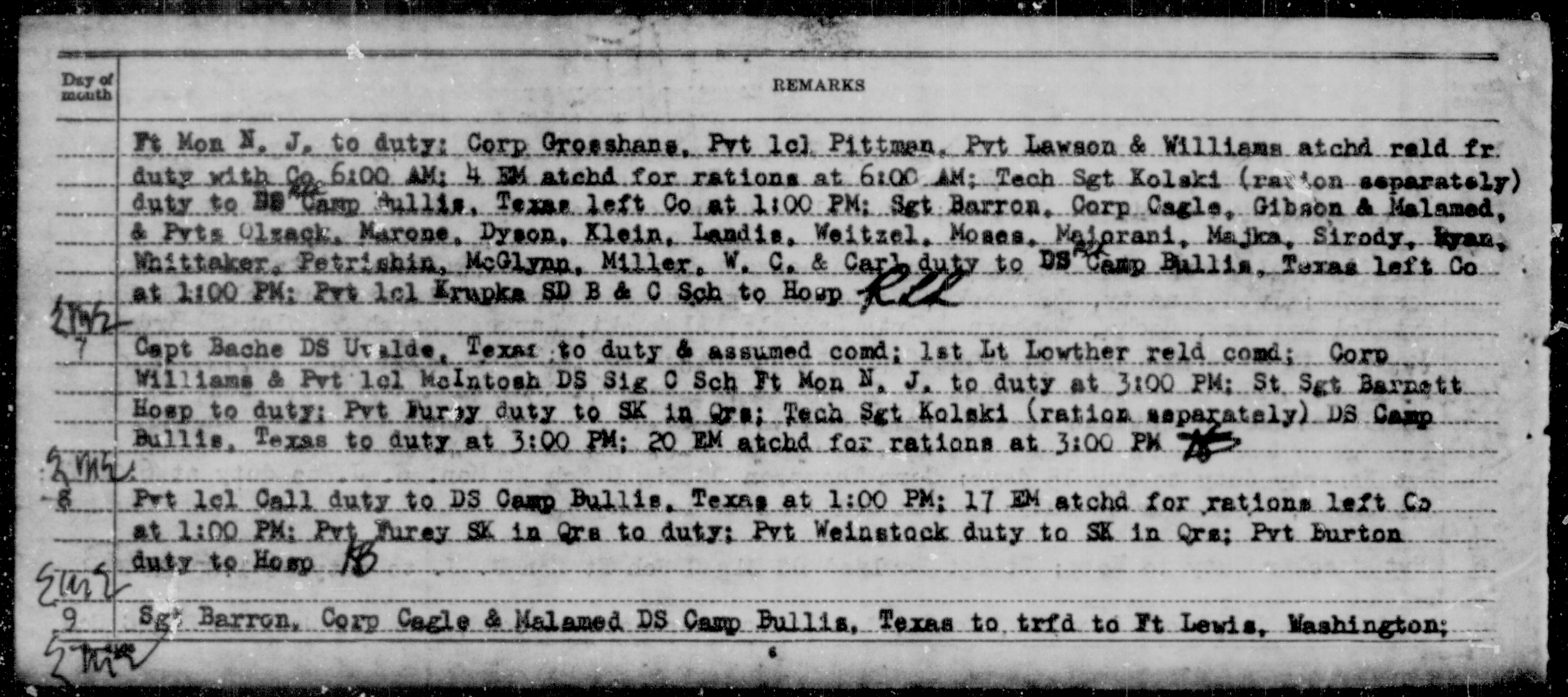
In the first week of May the company sends a party on detached service to Camp Bullis, outside San Antonio, among them “Sgt Barron, Corp Cagle, Gibson & Malamed.” On 9 May 1941 the report reads: “Sgt Barron, Corp Cagle & Malamed DS Camp Bullis, Texas to trfd to Ft Lewis, Washington.”

The 116th's history lists his next two companies as the 20th Radio Intelligence Company and the 125th Signal Radio Intelligence Company. Army lineage records show they are one company. The 20th was activated at Fort Lewis on 1 June 1941, three weeks after his transfer there, and renamed the 125th nine days later. A year on, he and Barron are staff sergeants in it. Newly discovered.
scanned record
May 1941. Bottom line, the 9th: “Sgt Barron, Corp Cagle & Malamed DS Camp Bullis, Texas to trfd to Ft Lewis, Washington.” The yellow is ours — it marks his name and service number on the sheet.
Source: Morning Report, Third Radio Intelligence Company, Fort Sam Houston, Texas: NARA Roll 2581, image 2677 (May 1941), NAID 440001084; History of the 116th Signal Radio Intelligence Company, from date of activation 18 May 1942 until V-J Day 2 September 1945 (the company's own 1945 history, a public-domain U.S. Government publication), page 9 of the Internet Archive scan; Department of the Army, Lineage and Honors certificate of the 525th Signal Company (formerly the 20th Radio Intelligence Company and 125th Signal Radio Intelligence Company), U.S. Army Center of Military History
Confirmed — Unit record
May 16, 1942

Sent to stand up a new company

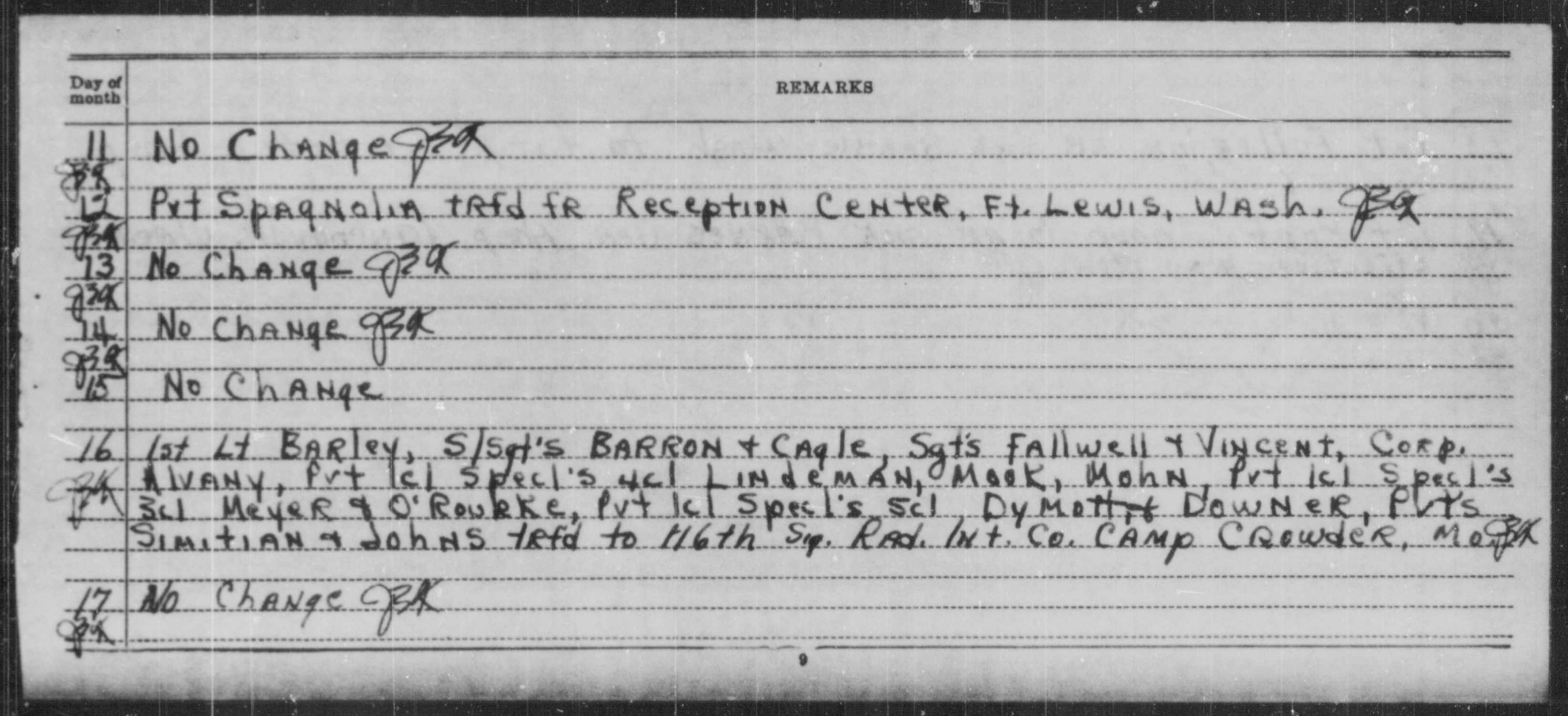
Cagle is a Staff Sergeant with the 125th Signal Radio Intelligence Company at Fort Lewis, Washington when the Army taps him as a cadreman: one of the small group of experienced men detached to build a brand-new unit from nothing. The 125th's own Morning Report for 16 May 1942 lists the party by name, in a clerk's handwriting:

“1st Lt Barley, S/Sgt's Barron + Cagle, Sgt's Fallwell + Vincent, Corp. Alvany … Mohn … Meyer + O'Rourke … Simitian + Johns trfd to 116th Sig. Rad. Int. Co., Camp Crowder, Mo.

Two days later the 116th Signal Radio Intelligence Company is activated. Barley would command it; Vincent, Mohn, Simitian and Meyer all turn up again beside Cagle in the records below. The 125th he left behind went to the Pacific and earned campaign credit for New Guinea and Leyte. Cagle went to Europe with the 116th. Newly discovered.
scanned record
The cadre transfer in the clerk's own hand: “S/Sgt's Barron + Cagle … trfd to 116th Sig. Rad. Int. Co., Camp Crowder, Mo.” The yellow is ours — it marks his name and service number on the sheet.
Source: Morning Report — 125th Signal Radio Intelligence Company, Fort Lewis, Washington — NARA Roll 2598, image 1616 (NAID 440083569, 16 May 1942); activation date from the History of the 116th Signal Radio Intelligence Company, from date of activation 18 May 1942 until V-J Day 2 September 1945 (the company's own 1945 history, a public-domain U.S. Government publication), page 64 of the Internet Archive scan; Department of the Army, Lineage and Honors certificate of the 525th Signal Company (formerly the 20th Radio Intelligence Company and 125th Signal Radio Intelligence Company), U.S. Army Center of Military History
Context
1942 – 1943

What a radio intelligence company was for

The 116th was a signals intelligence unit. Its men sat at receivers listening to enemy radio traffic, took direction-finding bearings to fix where enemy transmitters were, plotted those fixes on maps, and checked American units' own radio discipline for anything that gave the game away. Companies like it were the wartime ancestor of the Army Security Agency. Cagle's job in it was Communication Specialist. At Camp Crowder he taught radio procedure to the company for an hour a day and, with a few others, built the desks for the orderly room and the code tables for the code room, because there were none.
Confirmed — Unit record
June – July 1943

Master Sergeant with the Fort Dix detachment

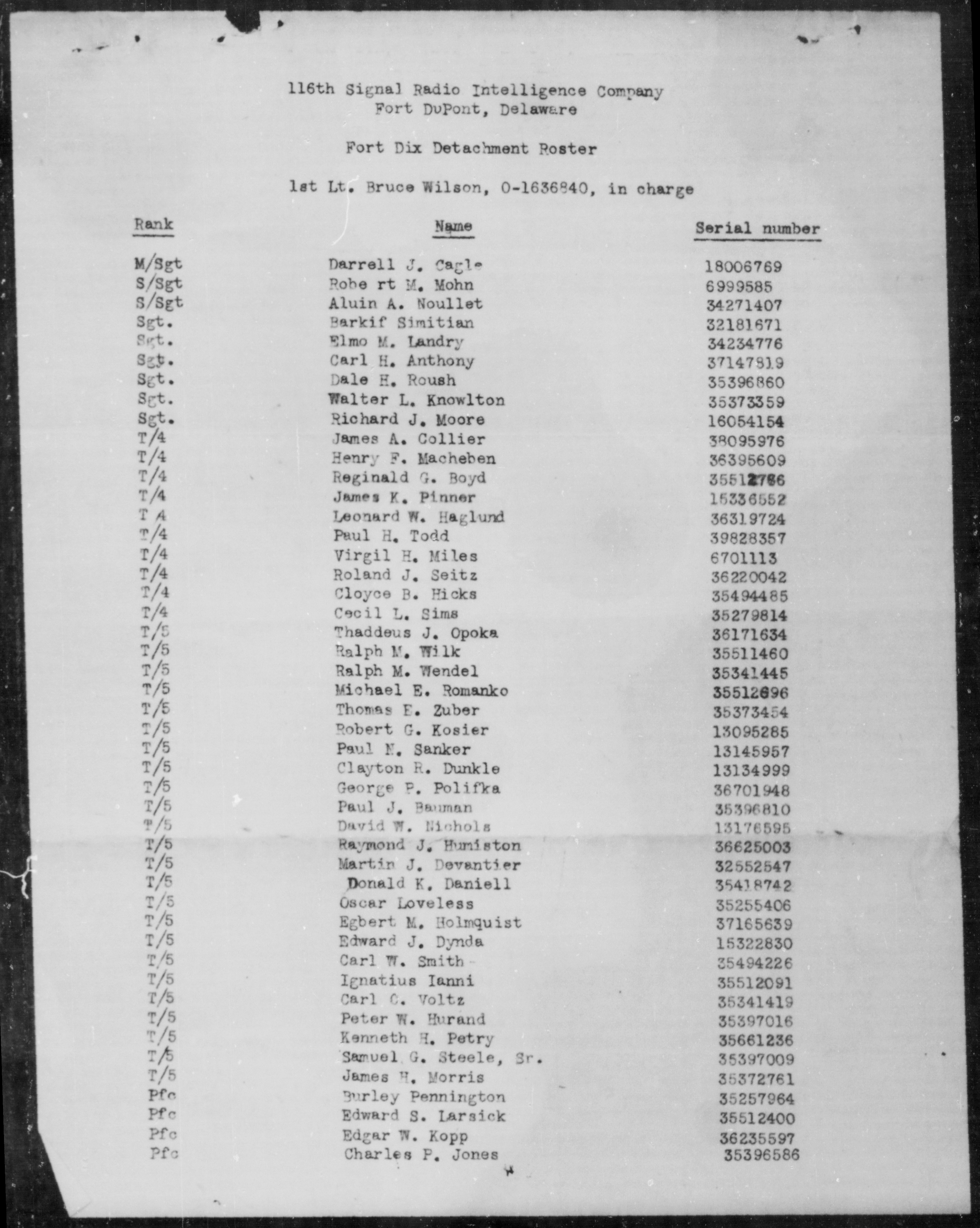
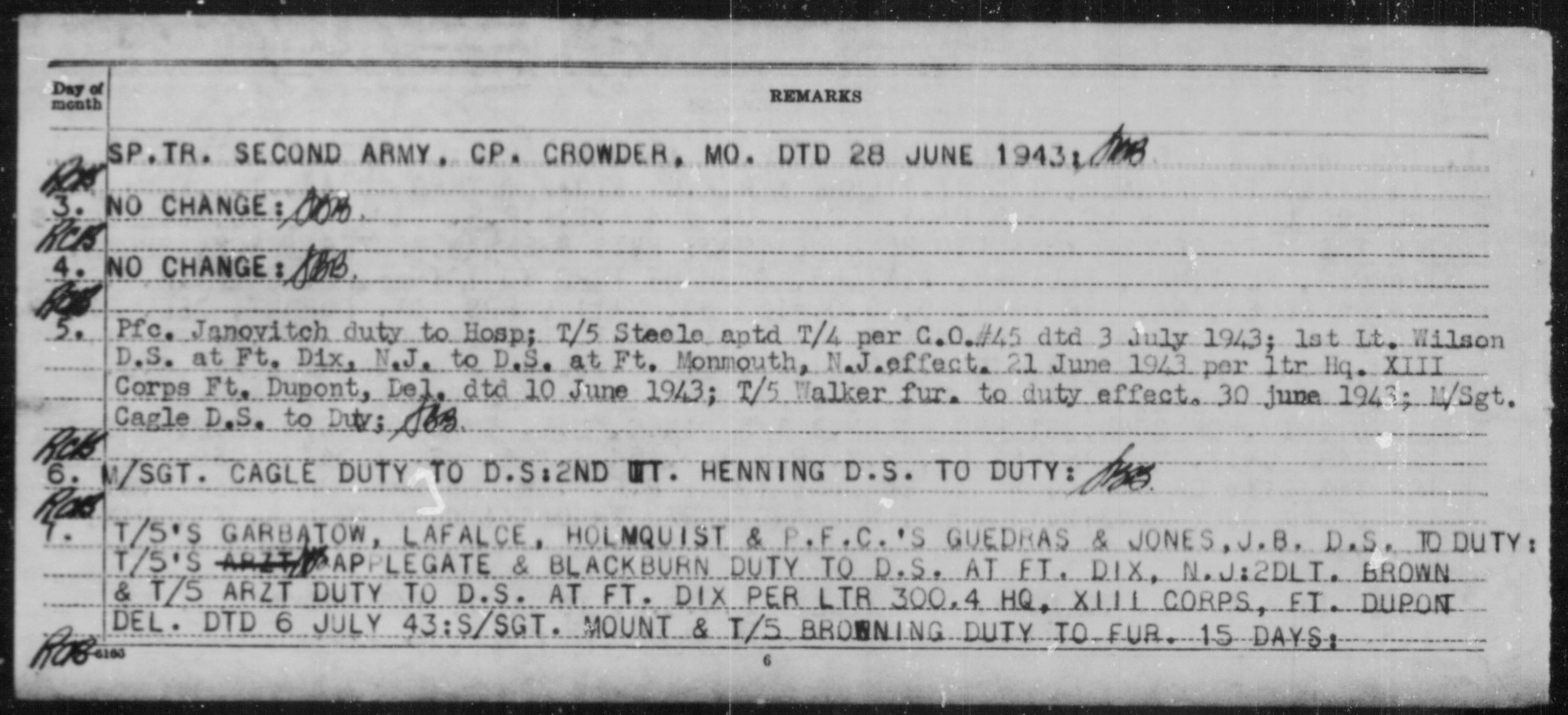
In May 1943 the company moves from Camp Crowder to Fort DuPont, Delaware. In June it sends a detachment to the 4th Motorized Division at Fort Dix, New Jersey: radio and direction-finding operators, control men, plotters, wire men and drivers, 68 men by the company history's count, under the command of 1st Lt. Bruce Wilson. Their job is to listen to the division's own radio nets and test how secure they are. The history puts M/Sgts Cagle and Vincent in charge of the men. The roster for the detachment survives, and his is the first name under the lieutenant's: M/Sgt · Darrell J. Cagle · 18006769.

The company's July report logs him coming and going: “M/Sgt. Cagle D.S. to Duty” on 5 July and “M/SGT. CAGLE DUTY TO D.S.” on the 6th. Its entry for 16 July returns sixty-five enlisted men from Fort Dix to duty with the company. Newly discovered.
scanned record
The Fort Dix Detachment Roster. Top line: M/Sgt Darrell J. Cagle, serial 18006769, under 1st Lt. Bruce Wilson. The yellow is ours — it marks his name and service number on the sheet.
scanned record
The 116th's report for early July 1943. The 5th: “M/Sgt. Cagle D.S. to Duty.” The 6th: “M/SGT. CAGLE DUTY TO D.S.” The yellow is ours — it marks his name and service number on the sheet.
Source: Morning Reports, 116th Signal Radio Intelligence Company, Fort DuPont, Delaware: Fort Dix Detachment Roster, NARA Roll 2202, image 2168 (NAID 438430032, June 1943); monthly report for July 1943, NARA Roll 2597, images 1946 (ration account naming M/Sgt. Cagle) and 1950 (NAID 440079515); History of the 116th Signal Radio Intelligence Company, from date of activation 18 May 1942 until V-J Day 2 September 1945 (the company's own 1945 history, a public-domain U.S. Government publication), pages 71 and 75 of the Internet Archive scan
Confirmed — Service record
July 17, 1943

Made a Warrant Officer

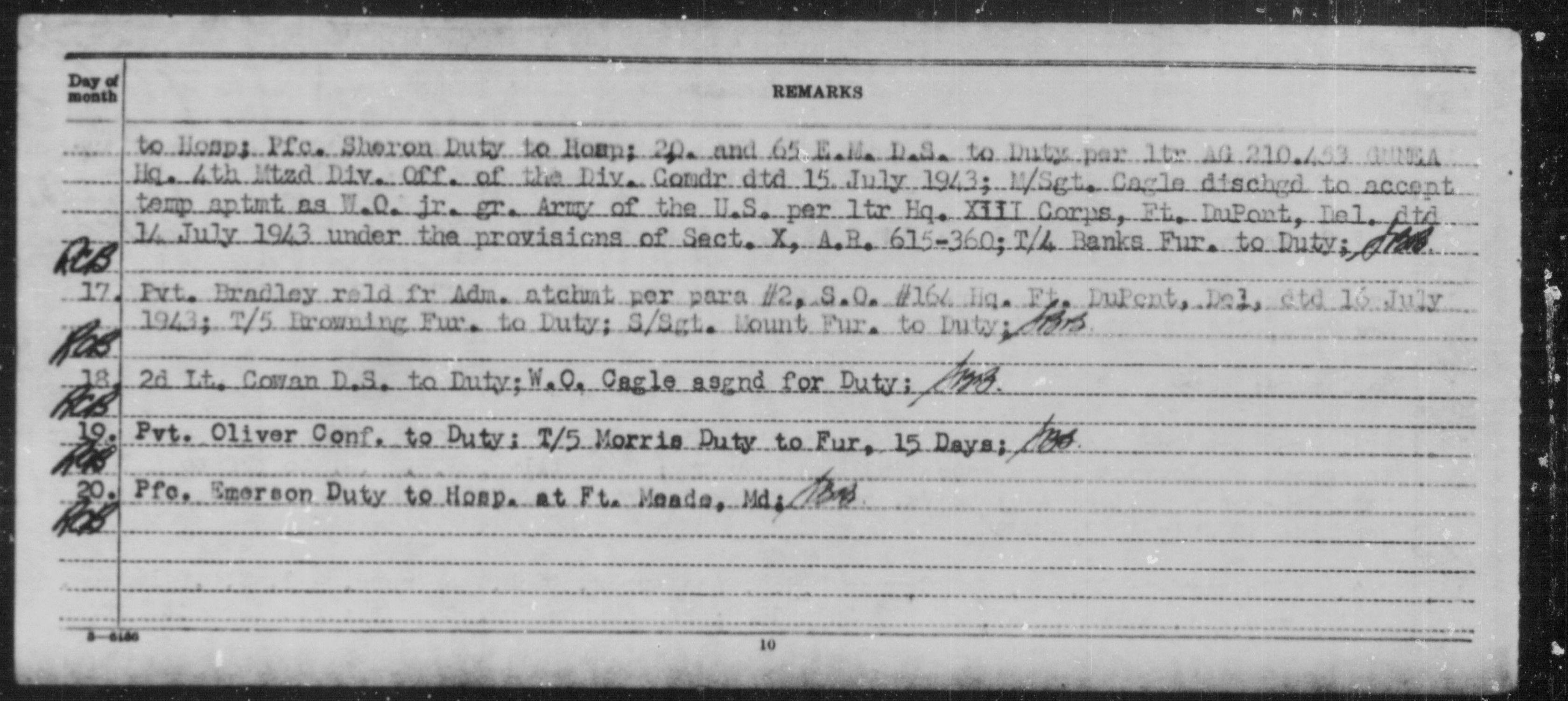
After thirty-three months in the ranks, the Army appoints Cagle a Warrant Officer (Junior Grade). His company's report records the mechanics. On 16 July 1943: “M/Sgt. Cagle dischgd to accept temp aptmt as W.O. jr. gr. Army of the U.S. per ltr Hq. XIII Corps, Ft. DuPont, Del. dtd 14 July 1943.” On the 18th: “W.O. Cagle asgnd for Duty.” The Veterans Administration dates his warrant service from 17 July, the day between. His company's history gives his job from then on as Communication Specialist.

The appointment gave him a new service number: W-2120969. Army clerks filed records by number, and from this day his old enlisted number, 18 006 769, stops appearing in them. Each Morning Report on this page after July 1943 lists him under the new one. Newly discovered.
scanned record
The 116th's report for mid-July 1943: “M/Sgt. Cagle dischgd to accept temp aptmt as W.O. jr. gr. Army of the U.S.” and, on the 18th, “W.O. Cagle asgnd for Duty.” The yellow is ours — it marks his name and service number on the sheet.
Source: Morning Report, 116th Signal Radio Intelligence Company, Fort DuPont, Delaware, monthly report for July 1943: NARA Roll 2597, image 1954 (NAID 440079515); U.S. Department of Veterans Affairs, Veterans Legacy Memorial, record AMAS-1615982 (the VA's record data dates his service from 17 July 1943; the public memorial page shows his rank and war periods); History of the 116th Signal Radio Intelligence Company, from date of activation 18 May 1942 until V-J Day 2 September 1945 (the company's own 1945 history, a public-domain U.S. Government publication), page 9 of the Internet Archive scan
Confirmed — Unit record
September 15 – October 21, 1943

Eight men to the West Virginia mountains

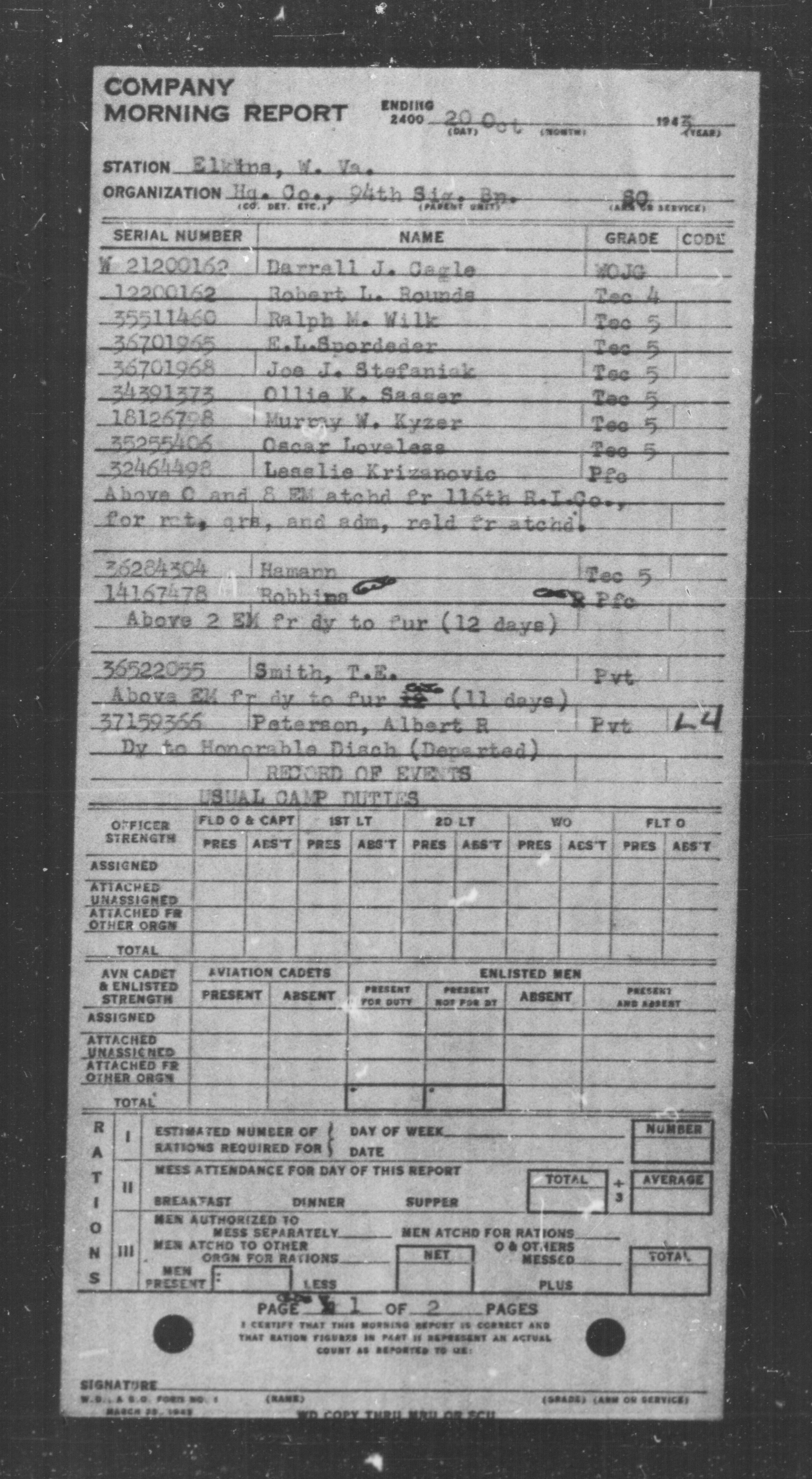
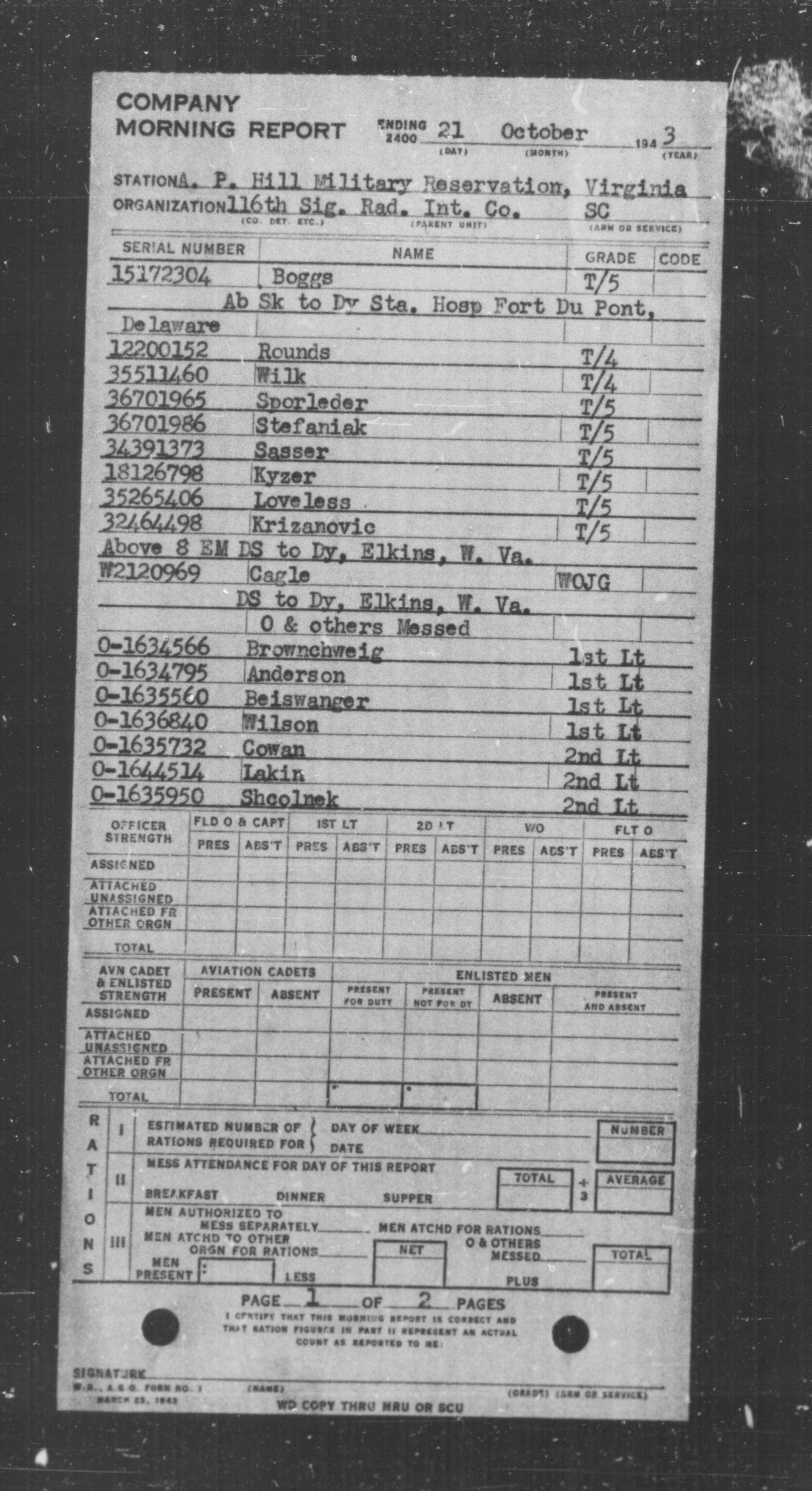
The company's first mission to the West Virginia Maneuver Area drew praise, and the Army called on it again. This time Cagle and eight men set off for Elkins, where they monitor the radio nets of the 77th and 31st Divisions. Four Morning Reports follow the trip from both ends.

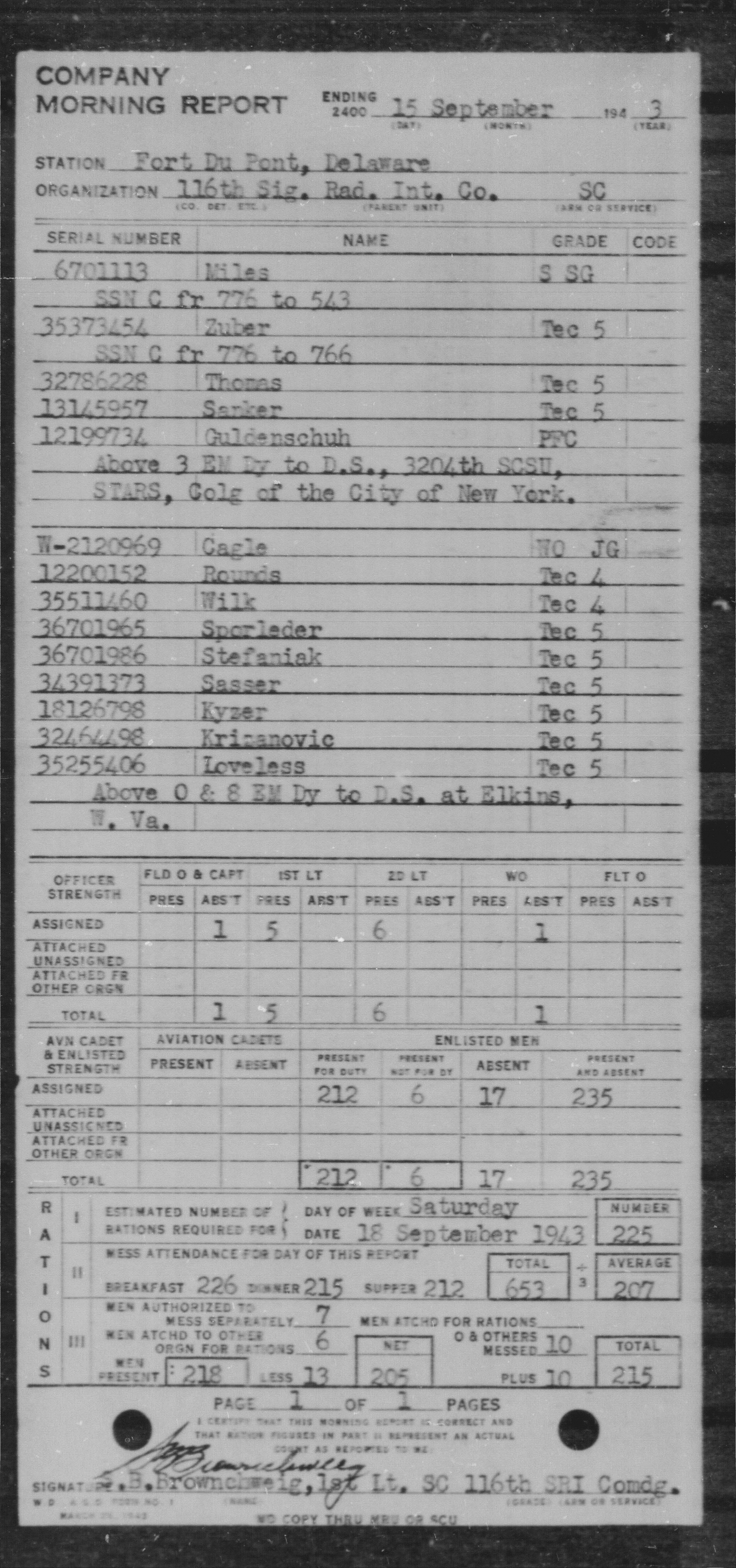
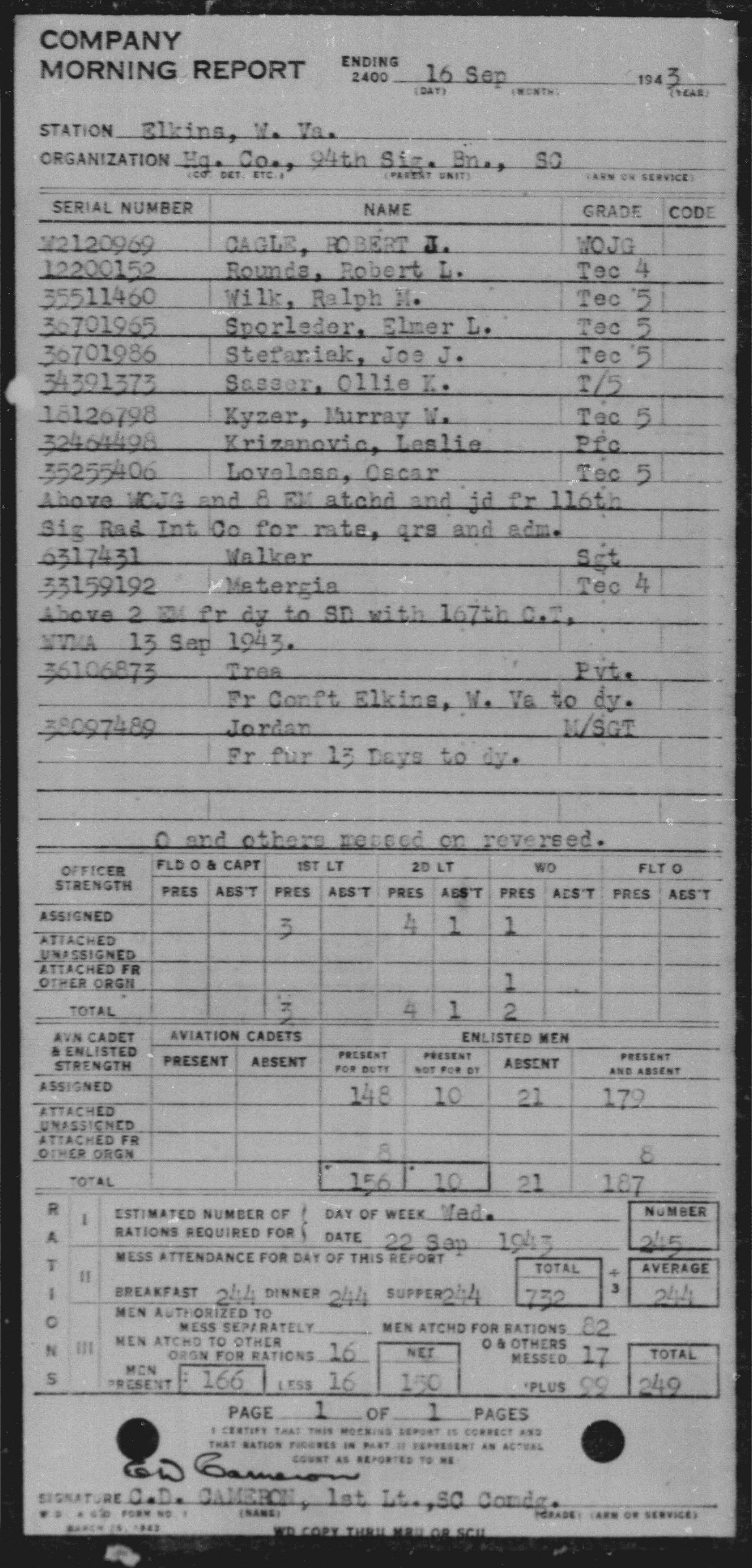
The 116th sends them from Fort DuPont on 15 September 1943: W-2120969 Cagle, WOJG, and eight enlisted men, “Above O & 8 EM Dy to D.S. at Elkins, W. Va.” The next day Headquarters Company, 94th Signal Battalion at Elkins takes the nine on its strength, “attached and joined from 116th Sig Rad Int Co for rations, quarters and administration.” On 20 October the 94th releases them, and on 21 October the 116th, by then at A. P. Hill, enters all nine “DS to Dy, Elkins, W. Va.”

Two clerical slips show on the 94th's pages. The September page types his first name as Robert, the name on the line below it; the number and grade are his. The October page spells his name in full and mistypes the number. The company history, written two years later, remembers the party staying away until 20 November. The reports made at the time bring it back on 21 October. Newly discovered.
scanned record
15 September 1943, the 116th at Fort DuPont: W-2120969 Cagle, WOJG, and eight men, “Above O & 8 EM Dy to D.S. at Elkins, W. Va.” The yellow is ours — it marks his name and service number on the sheet.
scanned record
16 September 1943: “W2120969 Cagle … WOJG” and eight men, attached from the 116th. The clerk has written the wrong first name; the serial, the grade and the eight men are his. The yellow is ours — it marks his name and service number on the sheet.
scanned record
20 October 1943, the same detachment released — and here the clerk writes his name in full: “Darrell J. Cagle WOJG”. The yellow is ours — it marks his name and service number on the sheet.
scanned record
21 October 1943, the 116th at A. P. Hill: the eight men and “W2120969 Cagle WOJG, DS to Dy, Elkins, W. Va.” The yellow is ours — it marks his name and service number on the sheet.
Source: Morning Reports: 116th Signal Radio Intelligence Company, NARA Roll 135, image 2608 (NAID 449700721, 15 Sep 1943) and Roll 121, image 1385 (NAID 452441655, 21 Oct 1943); Headquarters Company, 94th Signal Battalion, Elkins, West Virginia, Roll 135, image 2437 (NAID 449700721, 16 Sep 1943) and Roll 121, image 1212 (NAID 452441655, 20 Oct 1943); History of the 116th Signal Radio Intelligence Company, from date of activation 18 May 1942 until V-J Day 2 September 1945 (the company's own 1945 history, a public-domain U.S. Government publication), page 76 of the Internet Archive scan; the 116th's daily reports at Fort DuPont listing him, 1 to 13 September 1943: Roll 135, images 2590, 2596, 2598, 2601, 2604 and 2605 (NAID 449700721)
Confirmed — Unit record
October – December 1943

Field training at A. P. Hill

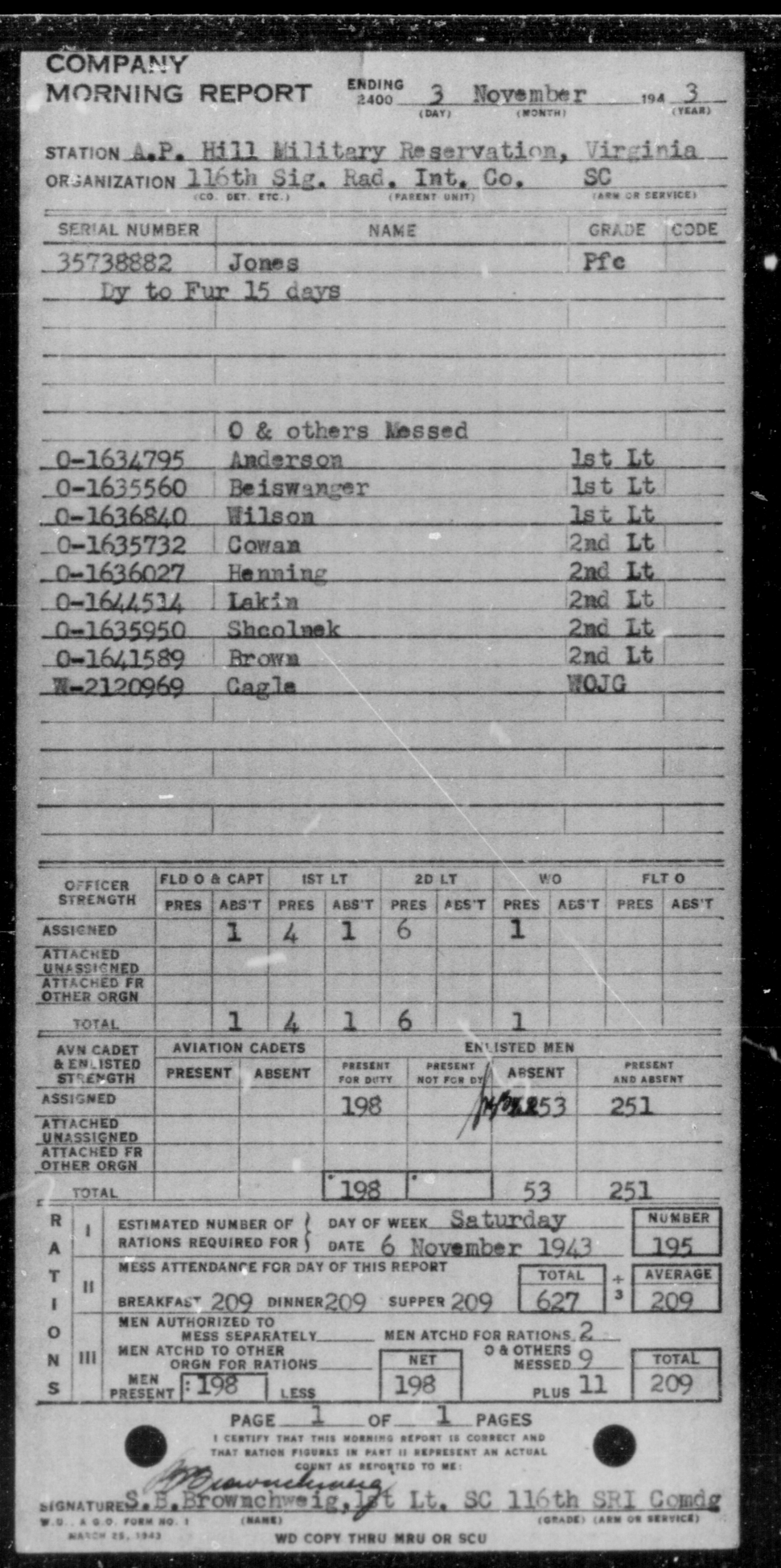
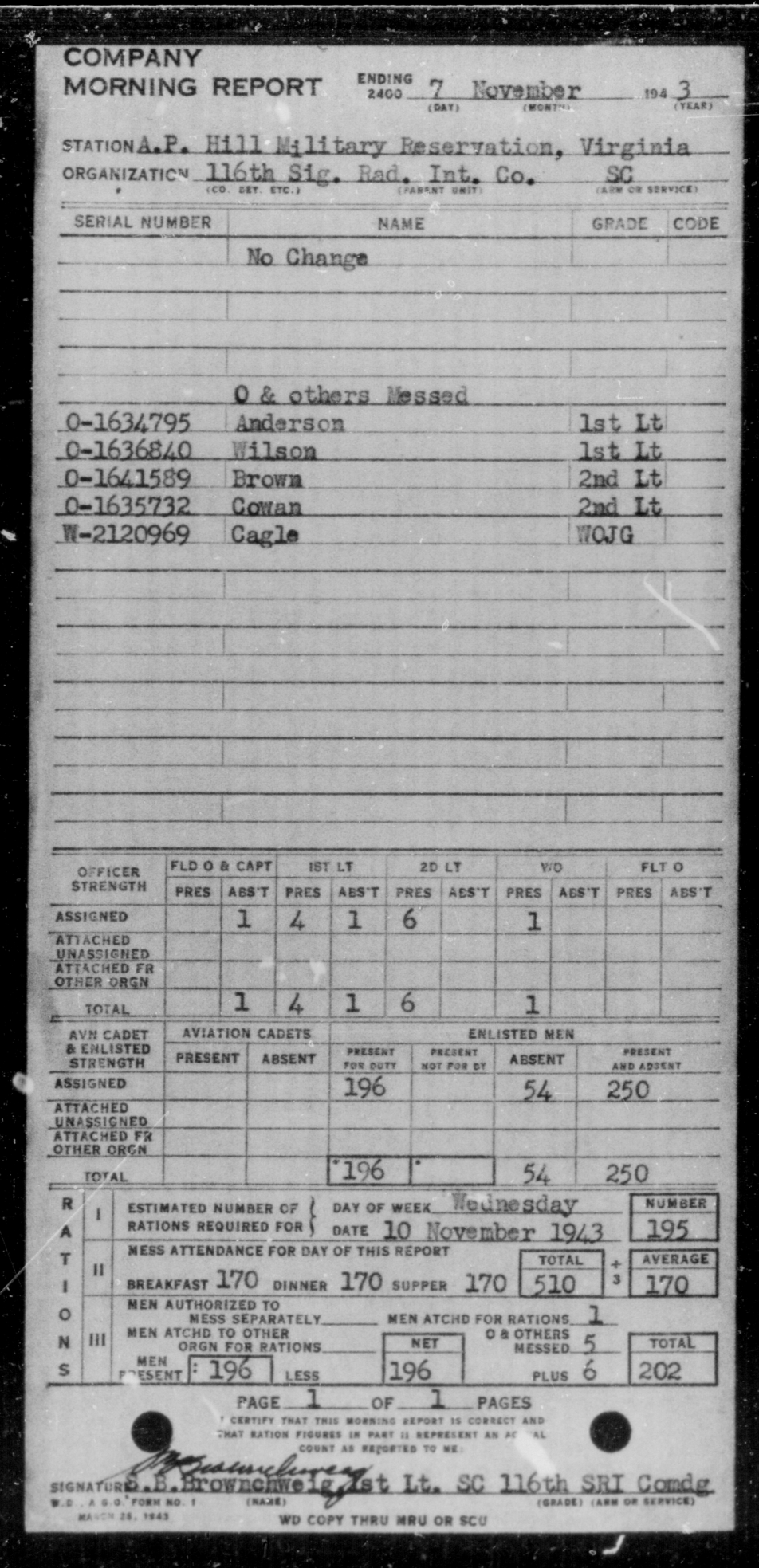
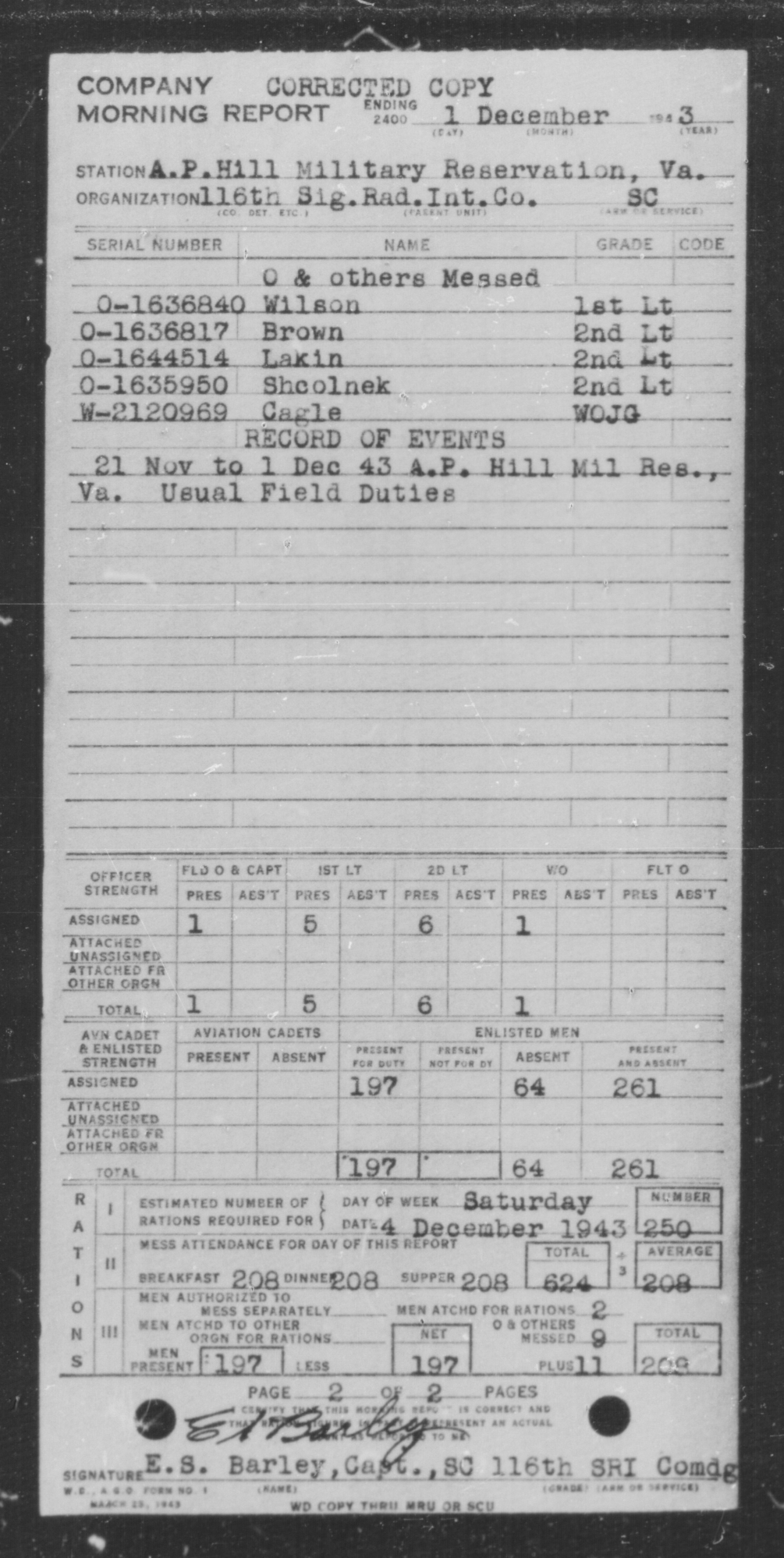
Back from West Virginia on 21 October, Cagle rejoins the company at the A. P. Hill Military Reservation in Virginia for its last stretch of field training in the United States. The Morning Reports shown here, for 3 and 7 November and 1 December, list him with the officers as W-2120969 Cagle, WOJG, the company's one warrant officer. Eighteen more daily reports between 24 October and 3 December list him the same way. The December report sums up a fortnight in three words: “Usual Field Duties.” Newly discovered.
scanned record
3 November 1943, A. P. Hill Military Reservation, Virginia. Last line of the officers' list: W-2120969 Cagle, WOJG. The yellow is ours — it marks his name and service number on the sheet.
scanned record
7 November 1943, the same station and the same line. The yellow is ours — it marks his name and service number on the sheet.
scanned record
1 December 1943, corrected copy signed by Capt. E. S. Barley: “21 Nov to 1 Dec 43 A.P. Hill Mil Res., Va. Usual Field Duties.” The yellow is ours — it marks his name and service number on the sheet.
Source: Morning Reports, 116th Signal Radio Intelligence Company, A. P. Hill Military Reservation, Virginia: NARA Roll 124, images 215 and 220 (NAID 455399448, 3 and 7 November 1943) and Roll 359, image 2781 (NAID 458757737, 1 December 1943); further daily reports listing him: Roll 121, images 1389, 1390, 1391, 1392, 1396 and 1397 (NAID 452441655, 24 to 30 October 1943); Roll 124, images 218, 221, 223, 224, 228, 230, 231, 236, 240, 242 and 243 (NAID 455399448, November 1943); Roll 359, image 2786 (NAID 458757737, 3 December 1943)
Confirmed — Unit record
December 1943 – January 1944

Vint Hill Farms Station

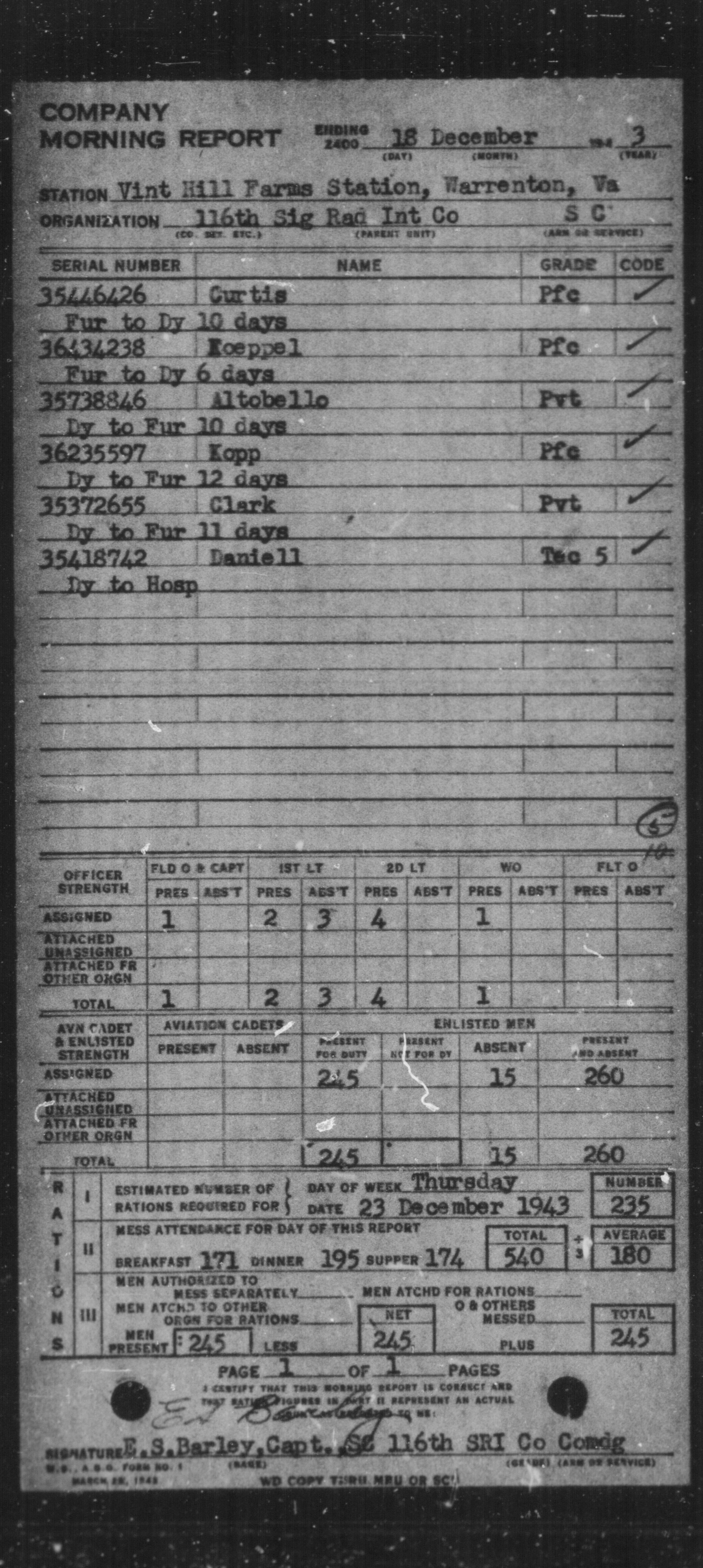
From A. P. Hill the company moves to Vint Hill Farms Station near Warrenton, Virginia, a Signal Corps monitoring station. Captain Barley signs the report there on 18 December 1943. It shows one warrant officer present, and the 116th had one: Cagle. The company's January reports carry the same station. Before the month ends it leaves for Camp Shanks and the ship. Newly discovered.
scanned record
Vint Hill Farms Station, Warrenton, Virginia, 18 December 1943, signed E. S. Barley. Officer strength: one warrant officer present.
Source: Morning Report, 116th Signal Radio Intelligence Company, Vint Hill Farms Station, Warrenton, Virginia: NARA Roll 25, image 3016 (NAID 457744143, 18 December 1943); January 1944 reports from the same station, NAID 460200523, images 709 and 710
Confirmed — Unit record
January 26, 1944

Camp Shanks — the last stop in America

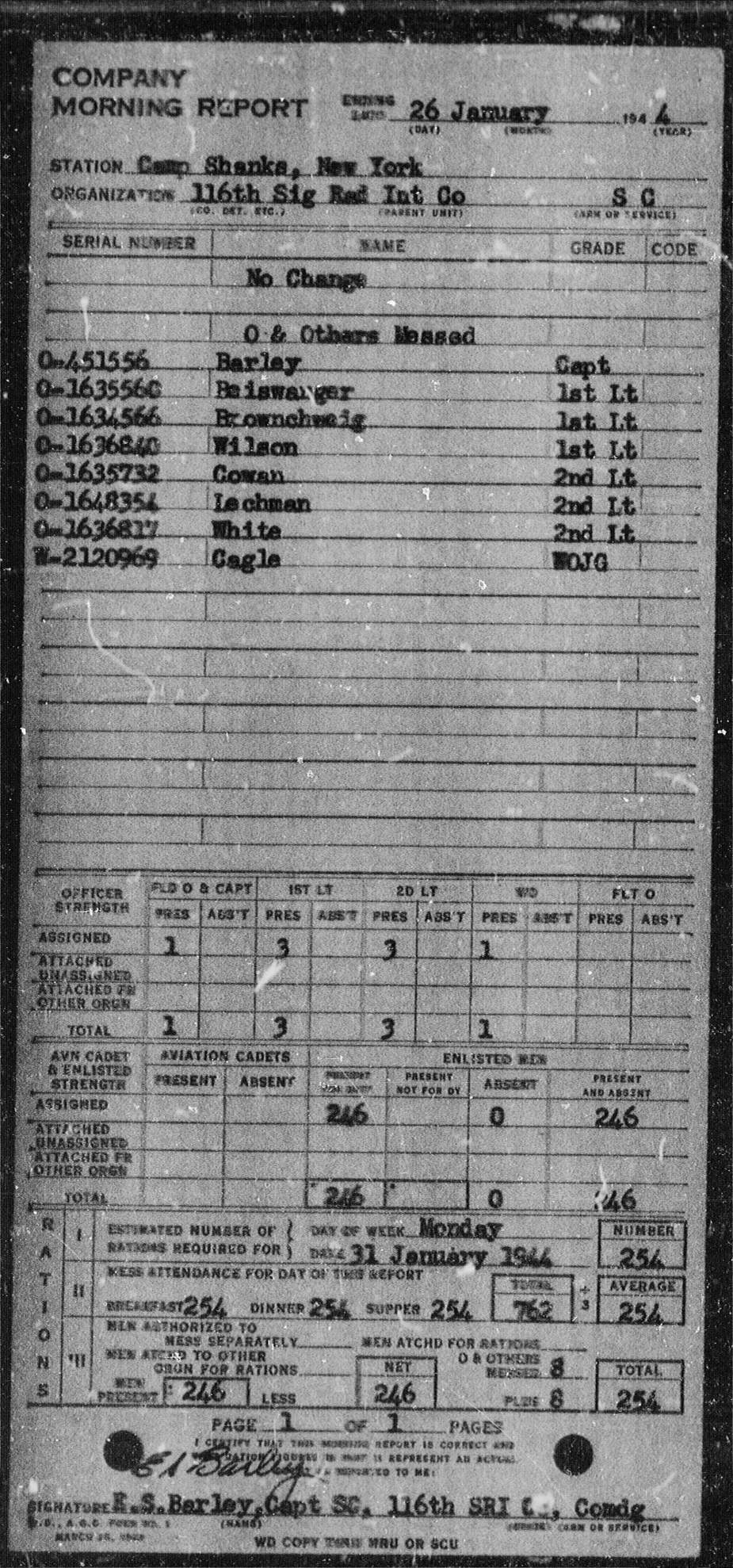
Five days before sailing, the company is at Camp Shanks, New York, the staging camp on the Hudson for the New York Port of Embarkation. Soldiers called it Last Stop USA. The report for 26 January lists Captain Barley, six lieutenants and W-2120969 Cagle, WOJG. Newly discovered.
scanned record
Camp Shanks, New York, 26 January 1944. Last line of the officers' list: W-2120969 Cagle, WOJG. The yellow is ours — it marks his name and service number on the sheet.
Source: Morning Report — 116th Signal Radio Intelligence Company, Camp Shanks, New York — NARA Roll 292, image 3199 (NAID 460988972, 26 January 1944)
Context
January 31, 1944

His company sails for England

At eleven in the morning the 116th sails from New York aboard the former liner RMS Mauretania, one of some eight or nine thousand men crammed aboard. A Navy blimp escorts them for a few hours and turns back. They raise the Isle of Man in early February and dock at Liverpool on 11 February 1944, reaching southern England after a night train through an air raid on the edge of London.
Confirmed — Unit record
February 13, 1944

Two in the morning at Pylewell House

The company's own Morning Report records the arrival to the hour:

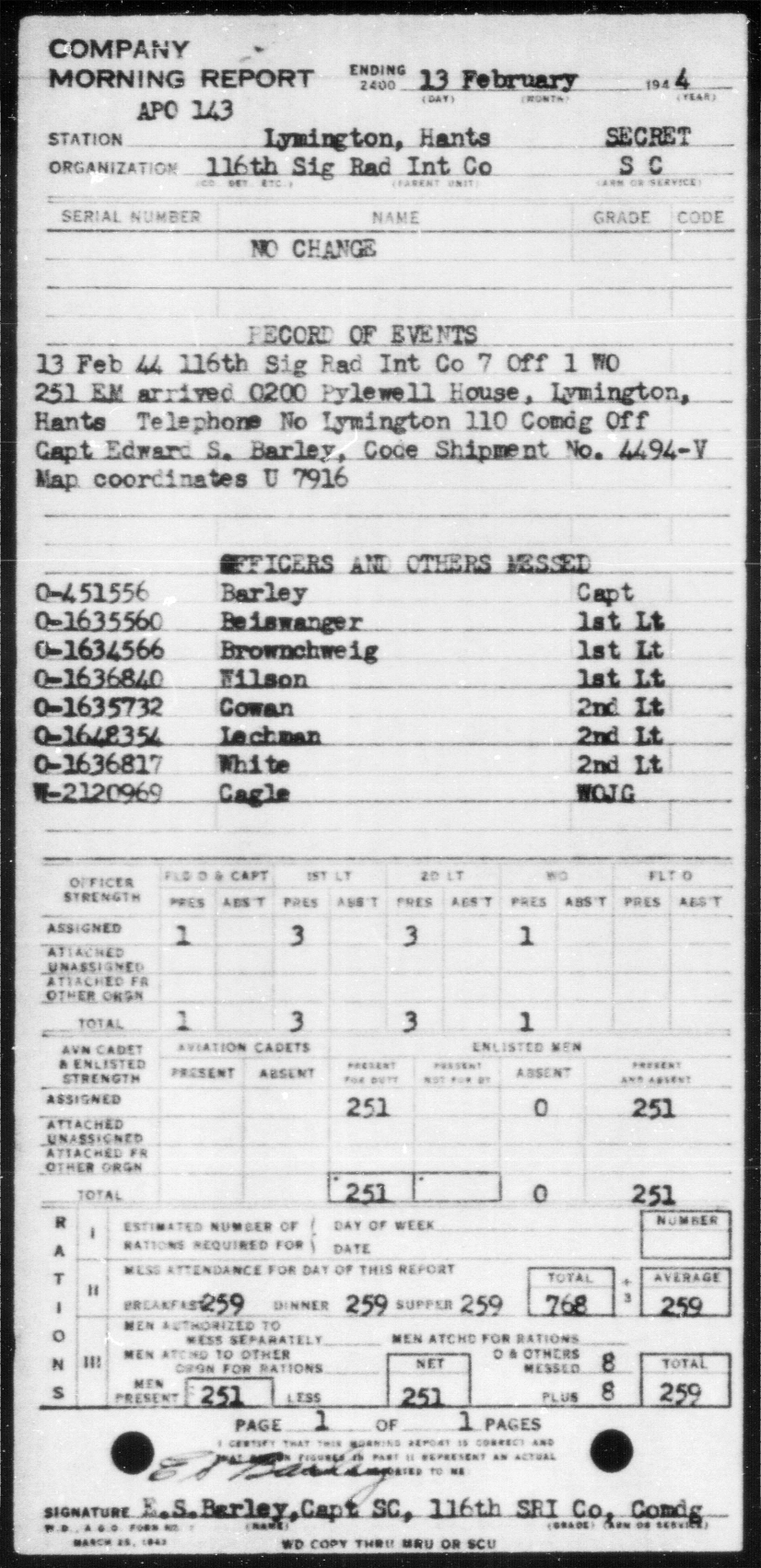
“13 Feb 44 116th Sig Rad Int Co 7 Off 1 WO 251 EM arrived 0200 Pylewell House, Lymington, Hants. Telephone No Lymington 110. Comdg Off Capt Edward S. Barley. Code Shipment No. 4494-V. Map coordinates U 7916.”

The “1 WO” is Cagle. He is listed by name underneath with the seven officers: W-2120969 · Cagle · WOJG. Pylewell House is a country estate on the Hampshire coast looking across to the Isle of Wight, and a Thunderbolt strip went up across the road from it almost overnight. Operations ran first out of the dining room, then out of huts mounted on the beds of two-and-a-half ton trucks. It was here, the company history says, that the men learned the true function of a radio intelligence unit. Newly discovered.
scanned record
“Arrived 0200 Pylewell House, Lymington, Hants … Code Shipment No. 4494-V”, with W-2120969 Cagle listed among the officers. The yellow is ours — it marks his name and service number on the sheet.
Source: Morning Report — 116th Signal Radio Intelligence Company, Lymington, Hampshire — NARA Roll 588, image 3270 (NAID 464515471, 13 February 1944); the company's daily reports at Lymington listing him through February and early March 1944: Roll 588, images 3271, 3273, 3274, 3275, 3277, 3279, 3280, 3281, 3283, 3284, 3285, 3286 and 3287 (NAID 464515471); images 2605, 2609, 2610, 2611 and 2612 (NAID 466316479); History of the 116th Signal Radio Intelligence Company, from date of activation 18 May 1942 until V-J Day 2 September 1945 (the company's own 1945 history, a public-domain U.S. Government publication), page 87 of the Internet Archive scan
Confirmed — Unit record
May 14 – 20, 1944

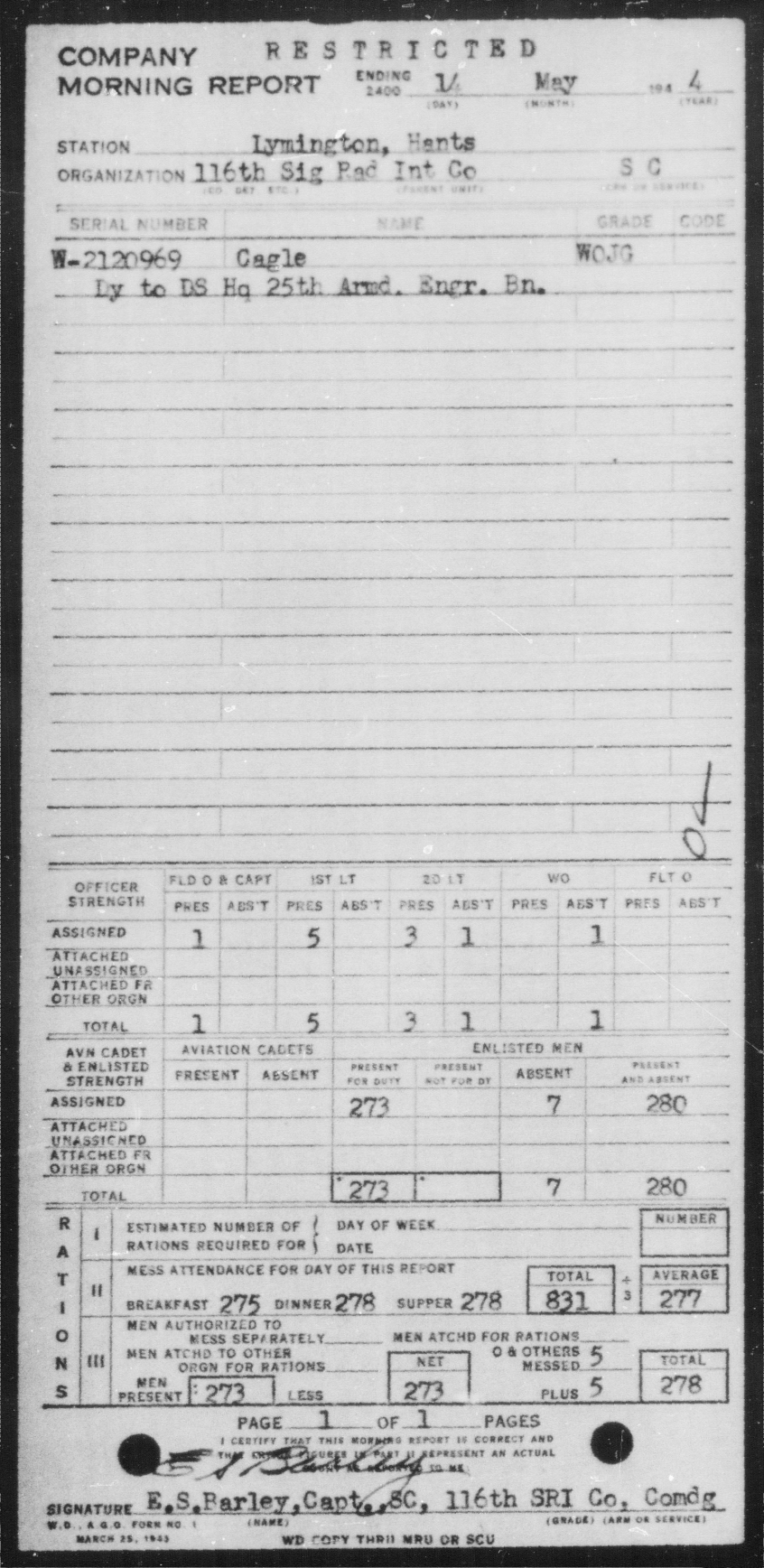
Detached to an armored engineer battalion

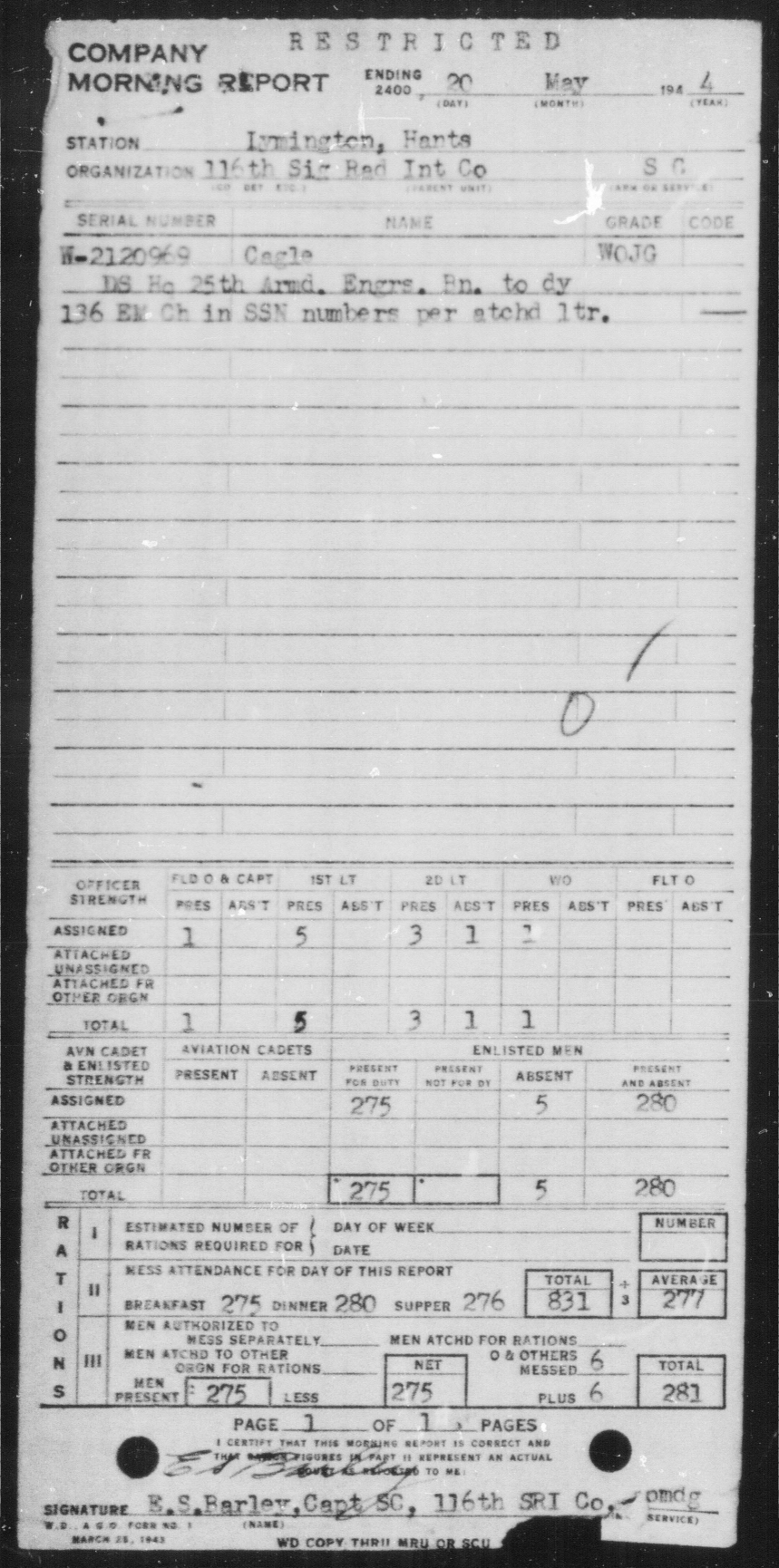
Three weeks before the invasion, the company sends Cagle away alone. Its Morning Report for 14 May 1944 reads: “W-2120969 Cagle WOJG, Dy to DS Hq 25th Armd. Engr. Bn.” That is duty to detached service with the headquarters of the 25th Armored Engineer Battalion, the engineer battalion of the 6th Armored Division, then training in England. The report for 20 May 1944 returns him to duty with the 116th. Neither report states the purpose of the six days. Newly discovered.
scanned record
14 May 1944: “W-2120969 Cagle WOJG, Dy to DS Hq 25th Armd. Engr. Bn.” The yellow is ours — it marks his name and service number on the sheet.
scanned record
20 May 1944, back to the company: “DS Hq 25th Armd. Engrs. Bn. to dy.” The yellow is ours — it marks his name and service number on the sheet.
Source: Morning Reports, 116th Signal Radio Intelligence Company, Lymington, Hampshire: NARA Roll 493, image 3097 (NAID 474264253, 14 May 1944) and image 3103 (20 May 1944). The battalion's parent division is from the 6th Armored Division order of battle published by the division association (super6th.org)
Context
April – June 1944

Six weeks before D-Day

Whatever the 116th was listening to that spring, it mattered. The Chief Signal Officer commended the company for producing radio intelligence vital to the war effort for the period six weeks prior to D-Day.

The rest of the company caught up in stages: the intelligence platoon spent two months training in London and rejoined at Pylewell on 22 April.
Context
August 9, 1944

Ashore over Omaha Beach

Two months after D-Day the company crosses to France on a Liberty ship its history names the Robert S. Peary, most likely the SS Robert E. Peary, unloading its trucks onto navy barges under an air attack that spattered shrapnel against the ship's side. The tide drove the barge back twice. On the third attempt the last of the 116th rolled ashore over Omaha Beach on 9 August 1944.
Confirmed — Unit record
August 22, 1944

Clearing the mines at Laval

The 116th breaks out of the Normandy peninsula behind Patton's Third Army, heading for Laval. Someone had to make the next camp safe before the company moved in, and the company history gives that job to Cagle: a handful of men “accompanied CWO Cagle on the demining operation to ready the Laval area for unit occupancy.” They came back dishevelled and full of stories about the mines they had found.
Confirmed — Unit record
September 16, 1944

Promoted to Chief Warrant Officer

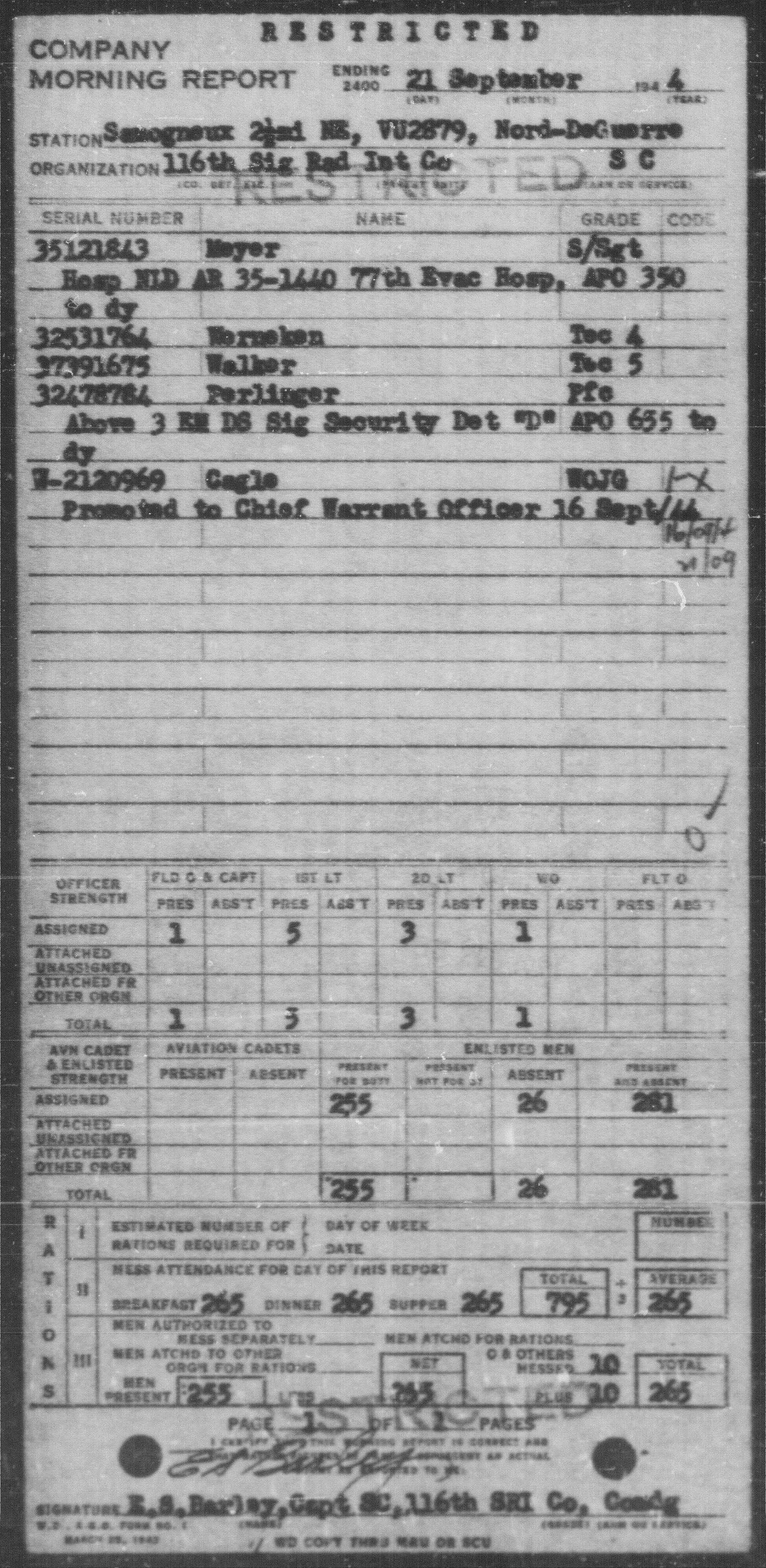
His own company records it first. The 116th's Morning Report for 21 September 1944, filed from Samogneux in the Meuse a few miles north of Verdun and signed by Captain E. S. Barley — the same officer who led the cadre out of Fort Lewis two years earlier — carries one line for him:

W-2120969 Cagle WOJG — Promoted to Chief Warrant Officer 16 Sept/44”

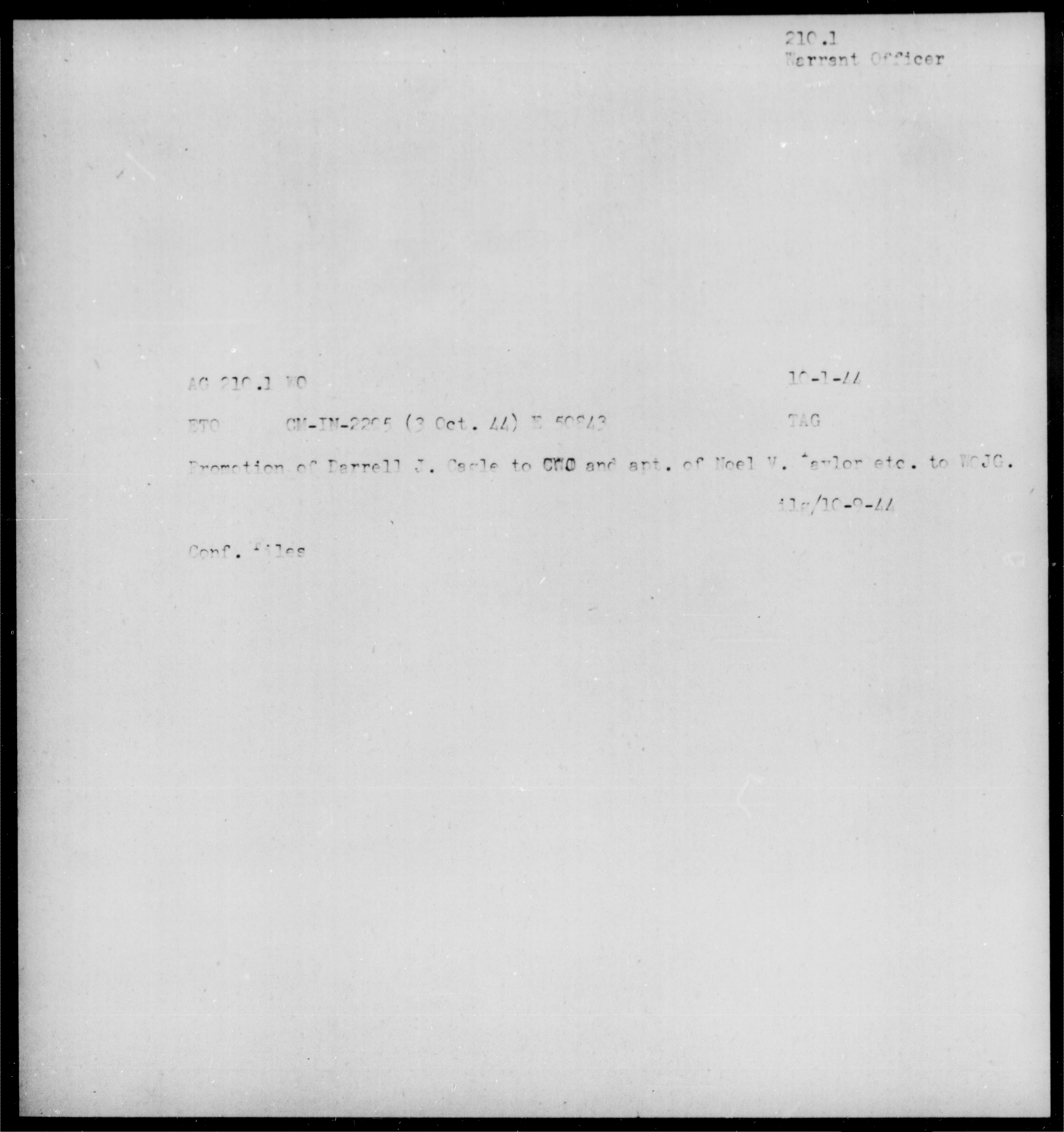
Washington caught up a fortnight later. A message came back from the European Theater of Operations to the War Department and a clerk filed it under decimal 210.1, Warrant Officer: “Promotion of Darrell J. Cagle to CWO.” He is now a Chief Warrant Officer, the rank on his headstone. The War Department filed two more copies of the same message, one of them in the personnel folder of Noel V. Taylor, the warrant officer appointed by the same order. Newly discovered.
scanned record
His own company's Morning Report from Samogneux, signed by Capt. E. S. Barley: “W-2120969 Cagle WOJG — Promoted to Chief Warrant Officer 16 Sept/44.” The yellow is ours — it marks his name and service number on the sheet.
scanned record
The War Department's own copy, filed in Washington: “ETO — CM-IN-2205 (3 Oct. 44) — Promotion of Darrell J. Cagle to CWO.” The yellow is ours — it marks his name and service number on the sheet.
Source: Morning Report, 116th Signal Radio Intelligence Company, Samogneux, France: NARA Roll 496, image 904 (NAID 569391228, 21 Sep 1944); and War Department Adjutant General file card, decimal 210.1 “Warrant Officer”, ETO message CM-IN-2205 (3 Oct. 1944), NARA RG 407, NAID 662916282, image 1152 (further copies at NAID 662925416, image 1552, and NAID 665580779, image 7)
Confirmed — Unit record
December 1944 – February 1945

Bettembourg, Luxembourg, and a plan for holding on

The company spends the winter at Bettembourg, in Luxembourg, which its history spells Bettemburg. On 16 December 1944 the Germans attacked through the Ardennes. The company's own account of the days that followed:

“The 116th Sig. Rad. Int. Co. was the only one of its type that did not pull out, and for days it was the only source of tactical information in that sector available to Allied Intelligence Service. For a time it was touch and go with the enemy drawing ever closer and constantly threatening. The crew from Dog-Fox 4 was forced to abandon their equipment and fall back. It looked as though the entire unit would soon have to pack and move. Here was born CWO Cagle's defense system for the security of the company. But with only one 50 cal. machine gun available for use, and a few grenades that were ‘not to be used’…”

By the history's account the other companies of its type pulled back, the 116th stayed and kept listening, and the plan for defending the position was Cagle's. The same pages record a lighter night that autumn. With reports of paratroopers going round, three men of the company fired a few rounds at an “attacking enemy” in the dark, and the history has “CWO Cagle, representing the U.S. government's interest,” buying “a lead filled cow.”
Confirmed — Unit record
December 26, 1944

Bettembourg, the day after Christmas

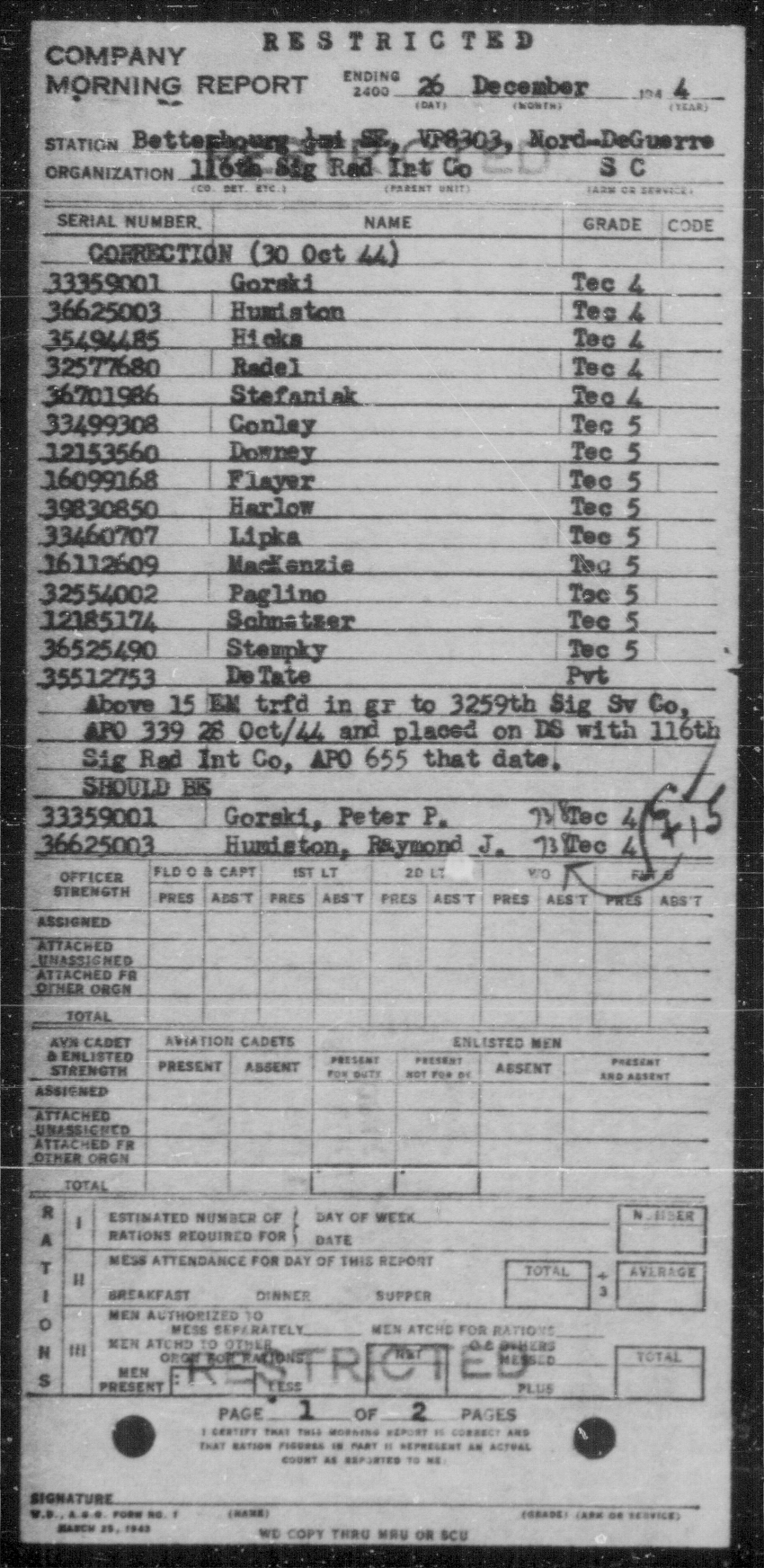
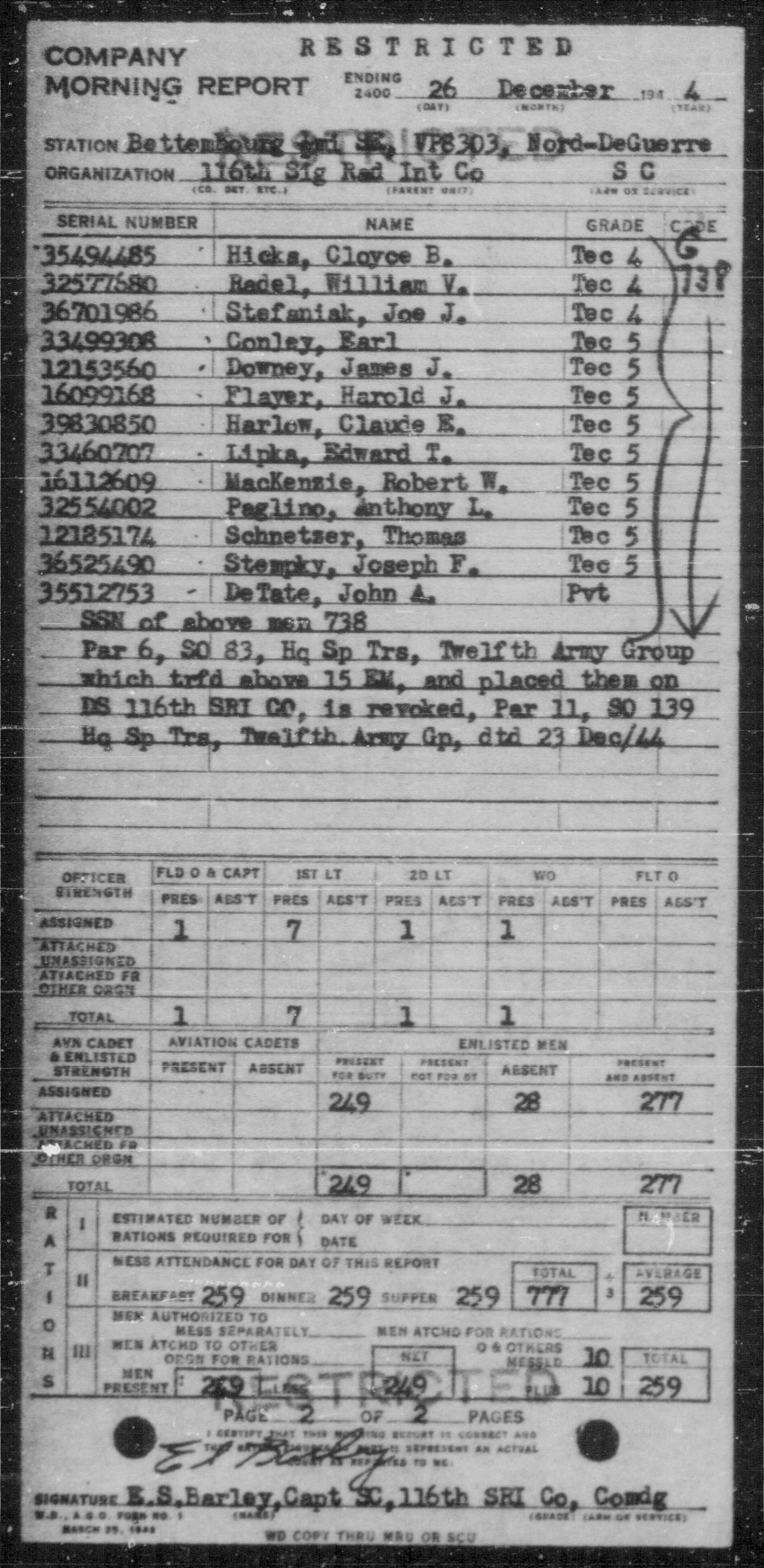
Ten days into the German offensive, Captain Barley signs the company's Morning Report at Bettembourg, Luxembourg. The officer strength shows one warrant officer present. The page does not name him, but each 1944 report on this page shows the 116th with one warrant officer, and each report that names that officer names Cagle. Two of the men listed, Cloyce B. Hicks and Joe J. Stefaniak, carry the same serial numbers they had on his Fort Dix roster eighteen months and an ocean earlier.

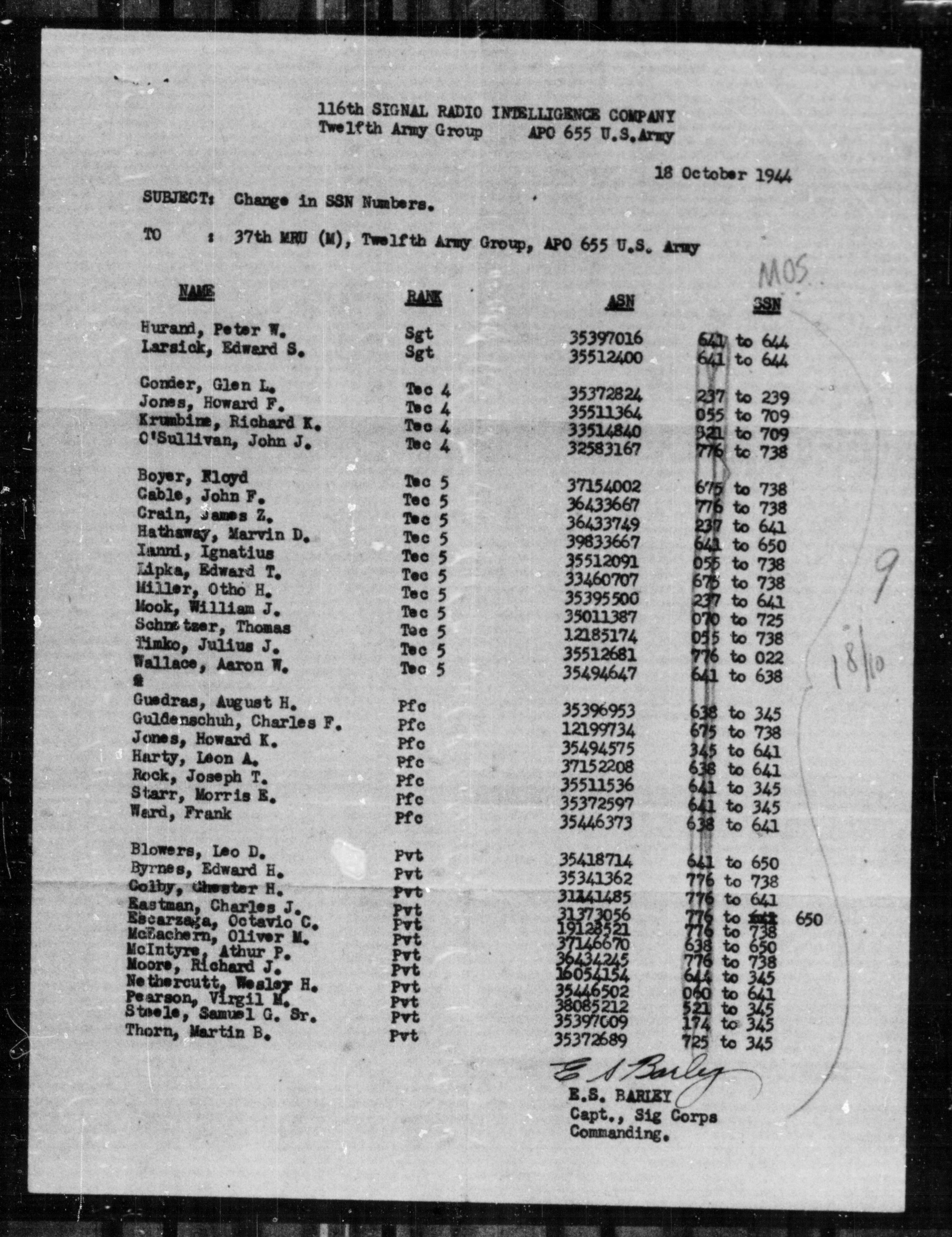
The report cites orders of Headquarters Special Troops, Twelfth Army Group, moving fifteen men on and off detached service with the company. The company's own letterhead names the same headquarters. A letter Captain Barley signed on 18 October 1944 is headed “116th Signal Radio Intelligence Company, Twelfth Army Group, APO 655.” Twelfth Army Group was General Bradley's command. Newly discovered.
scanned record
Bettembourg, 26 December 1944, page 1: fifteen men of the 3259th Signal Service Company on detached service with the 116th.
scanned record
Page 2, signed E. S. Barley, Capt. SC, 116th SRI Co, Commanding. Officer strength: one warrant officer present. The orders cited are those of Hq Special Troops, Twelfth Army Group.
scanned record
18 October 1944: the company's letterhead, “116th Signal Radio Intelligence Company, Twelfth Army Group, APO 655 U.S. Army”, signed E. S. Barley.
Source: Morning Report, 116th Signal Radio Intelligence Company, Bettembourg, Luxembourg: NARA Roll 678, images 2804 and 2805 (NAID 579481629, 26 December 1944); company letter of 18 October 1944, NARA Roll 536, image 958 (NAID 572779375)
Context
May 8, 1945

V-E Day, and a camp at Scheyern

The company leaves Bettembourg on 20 February 1945 and follows the armies east: Ovifat in Belgium, then Lommersum, Ittenbach across the Rhine, Borken and Apolda in Germany. On 4 May it goes under canvas near Hagelstadt, fifteen kilometres from Regensburg, to cover the front behind Third Army. The war in Europe ends there. Higher headquarters had found fault with the bivouac, so, in the history's words, “the 116th celebrated V-E Day by standing a full field inspection.”

Within days the company moves into a school building beside the monastery at Scheyern in Bavaria. The history records what Cagle did with it: “Mr. Cagle was determined from the start to transform the area into a smart and efficient camp,” and he kept the company's liaison man “travelling all over Germany to get utilities equipment and other supplies.”
Context
1944 – 1945

Four campaigns

The Army's official register credits the 116th Signal Radio Intelligence Company with four campaigns: Northern France, Rhineland, Ardennes-Alsace and Central Europe, and with occupation duty in Germany from 2 May to 27 December 1945. The company landed after the Normandy campaign closed, so it carries no credit for it. Campaign credit belongs to the unit. The records on this page show Cagle with the company in France in August 1944, at Samogneux in September, at Bettembourg through the Ardennes winter and at Scheyern in May 1945.

The company also received a letter of commendation from the Signal Officer of Twelfth Army Group, Brigadier General Garland C. Black, dated 29 May 1945 and reproduced in its history. It commends “each and every officer and enlisted man of your command.”
Confirmed — Record
Late 1945

His company writes him down

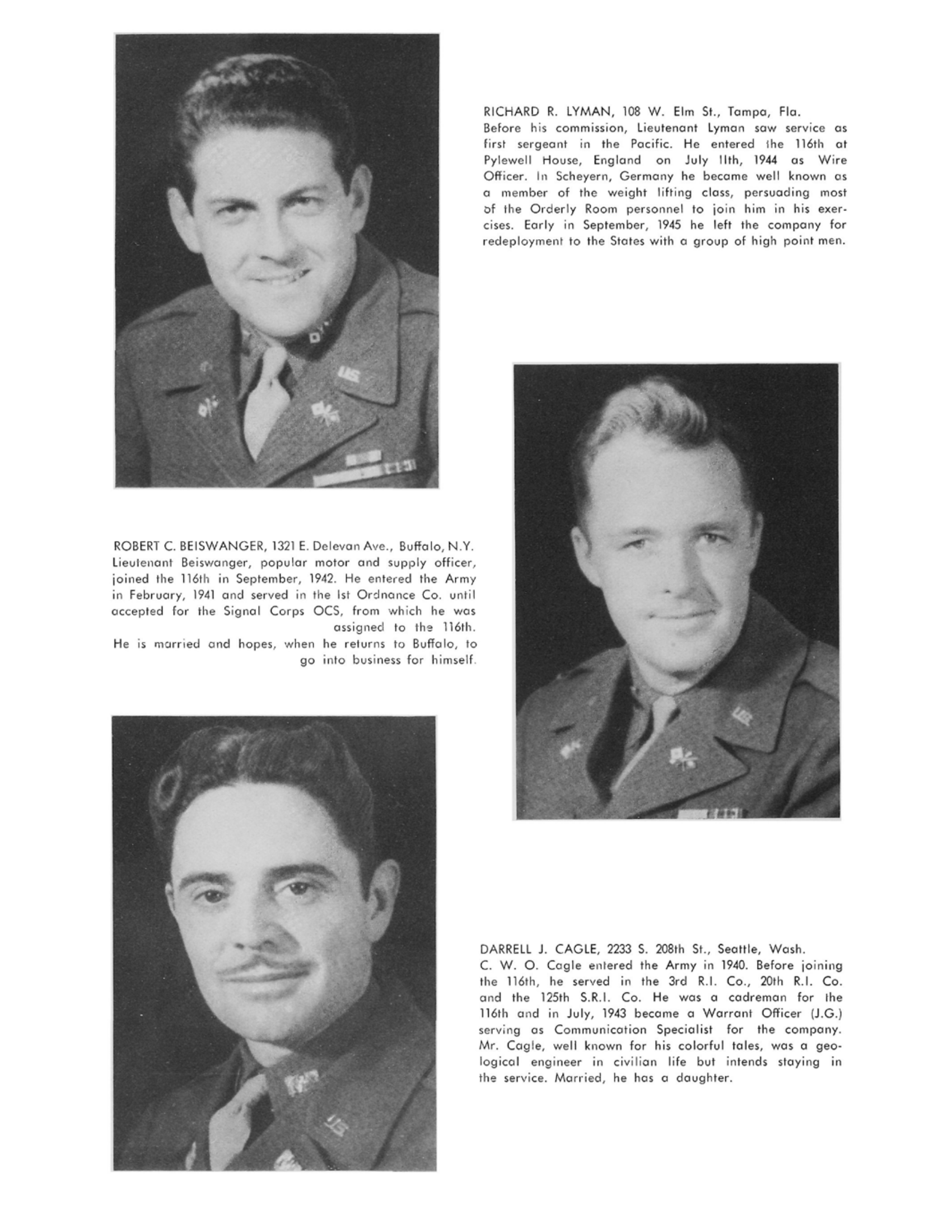
Before the 116th broke up it printed its own history: photographs, the story of every camp and country it had passed through, and pages of short write-ups on its officers. The one under Cagle's name reads:

“C. W. O. Cagle entered the Army in 1940. Before joining the 116th, he served in the 3rd R.I. Co., 20th R.I. Co. and the 125th S.R.I. Co. He was a cadreman for the 116th and in July, 1943 became a Warrant Officer (J.G.) serving as Communication Specialist for the company. Mr. Cagle, well known for his colorful tales, was a geological engineer in civilian life but intends staying in the service. Married, he has a daughter.”

Printed above it is his home address: 2233 S. 208th St., Seattle, Washington.
scanned record
Page 9 of the company history. The write-up on Cagle is at the bottom right; his photograph is the portrait opposite it, bottom left, the same picture that appears on his memorial today. The yellow is ours — it marks his name and service number on the sheet.
Confirmed — Record
January 1948 – 1950

Back at Fort Lewis, in radio intelligence again

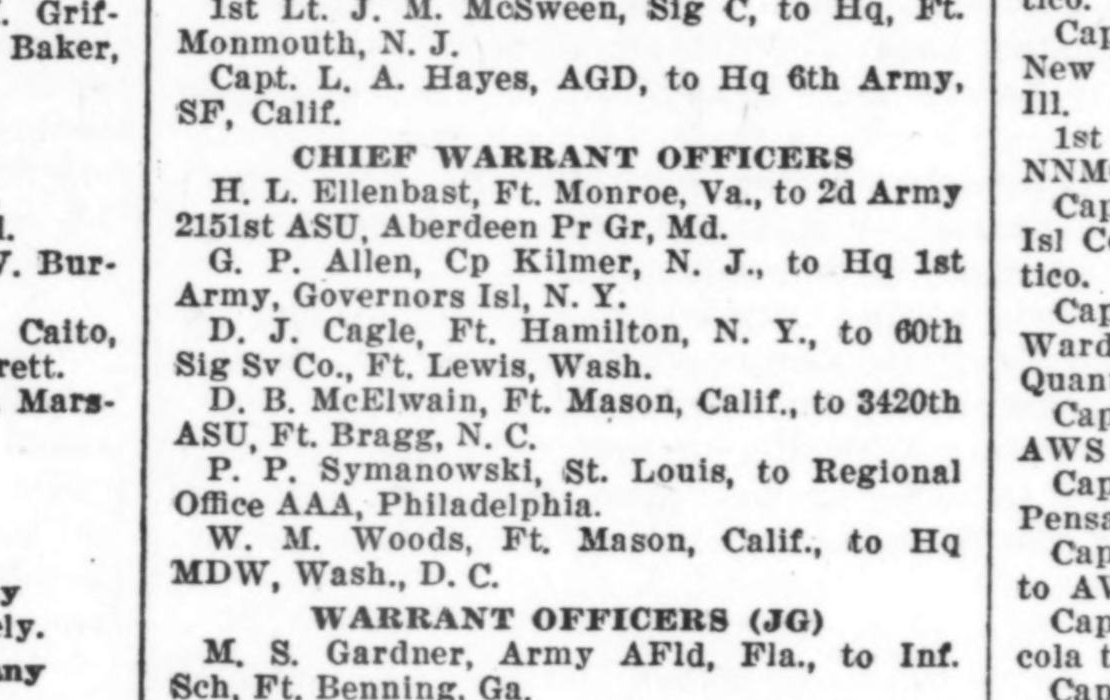
The Army's published orders pick him up after the war. Under the heading Chief Warrant Officers, the Army and Navy Journal of 10 January 1948 prints: “D. J. Cagle, Ft. Hamilton, N. Y., to 60th Sig Sv Co., Ft. Lewis, Wash.” Fort Lewis was the post he had left as a staff sergeant in 1942. The Radio Amateur Callbook for fall 1948 lists the amateur station W7LAL under his full name at the company's address: “Darrell J. Cagle, 60th Sig Service Co (RI) Bldg AC-89, near 15th Street, Fort Lewis, Wash.” RI stands for radio intelligence, the work he had done since 1940.

The Army's list of all its warrant officers, dated 15 June 1950, carries him as a Chief Warrant Officer, Army of the United States.

These published notices print no service number. The name, the grade and the line of work are his, and the 1950 list of the Army's 7,643 warrant officers shows one Darrell J. Cagle. Newly discovered.
scanned record
Army and Navy Journal, 10 January 1948, Army Orders: “D. J. Cagle, Ft. Hamilton, N. Y., to 60th Sig Sv Co., Ft. Lewis, Wash.” The yellow is ours — it marks his name and service number on the sheet.
scanned record
Radio Amateur Callbook, fall 1948: station W7LAL, Darrell J. Cagle, 60th Signal Service Company (RI), Fort Lewis. The yellow is ours — it marks his name and service number on the sheet.
Confirmed — Record
April 1953 – June 1954

Promoted, and ordered to Hawaii

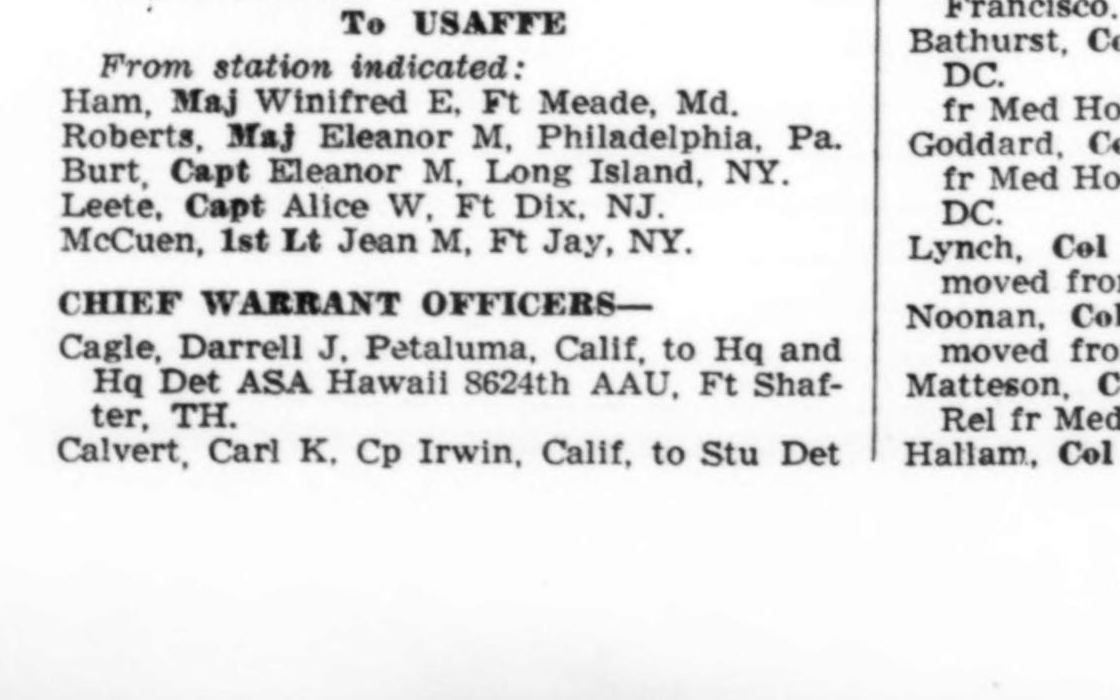
Army Times of 9 May 1953 lists Darrell J. Cagle among 820 warrant officers promoted to pay grade W-3, with a date of rank of 29 April 1953. A year later the Army Navy Air Force Journal prints his next move under Chief Warrant Officers:

“Cagle, Darrell J, Petaluma, Calif, to Hq and Hq Det ASA Hawaii 8624th AAU, Ft Shafter, TH.”

ASA is the Army Security Agency, the post-war home of the Army's radio intelligence work. Fort Shafter is on Oahu, in what was then the Territory of Hawaii. His family remembers service in both Europe and the Pacific. The wartime records on this page keep him in the United States until January 1944 and in Europe from then until the war ended, so this posting, in the Korean War period, is most likely the Pacific service they remember. Newly discovered.
scanned record
Army Times, 9 May 1953: Darrell J. Cagle in the list of warrant officers promoted to W-3. The yellow is ours — it marks his name and service number on the sheet.
scanned record
Army Navy Air Force Journal, 5 June 1954, Army Orders: “Cagle, Darrell J, Petaluma, Calif, to Hq and Hq Det ASA Hawaii 8624th AAU, Ft Shafter, TH.” The yellow is ours — it marks his name and service number on the sheet.
Confirmed — Service record
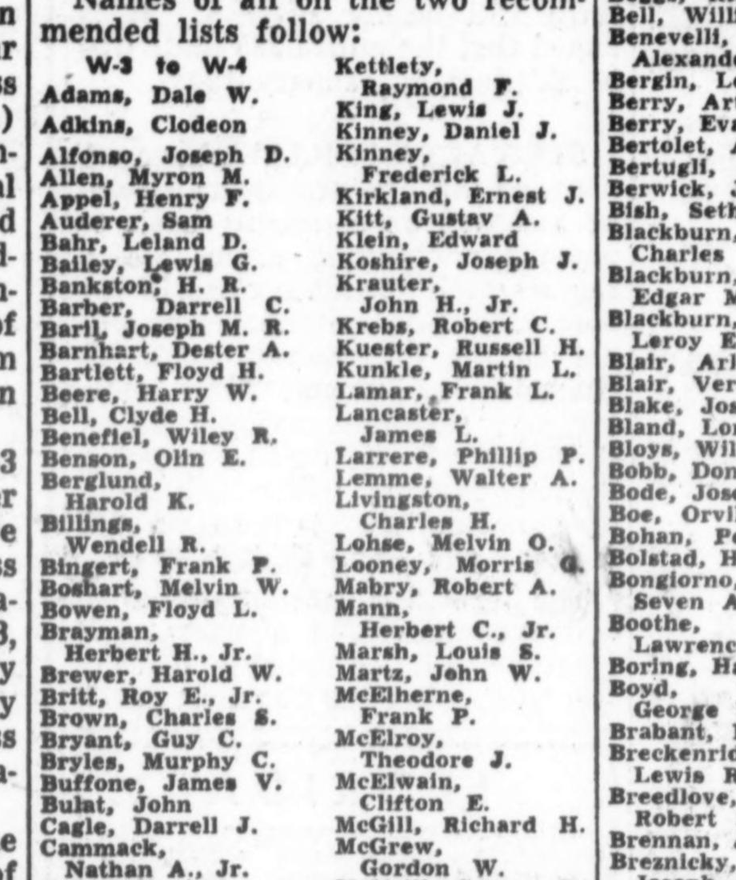
March 24, 1959

Retires as a Chief Warrant Officer, W-4

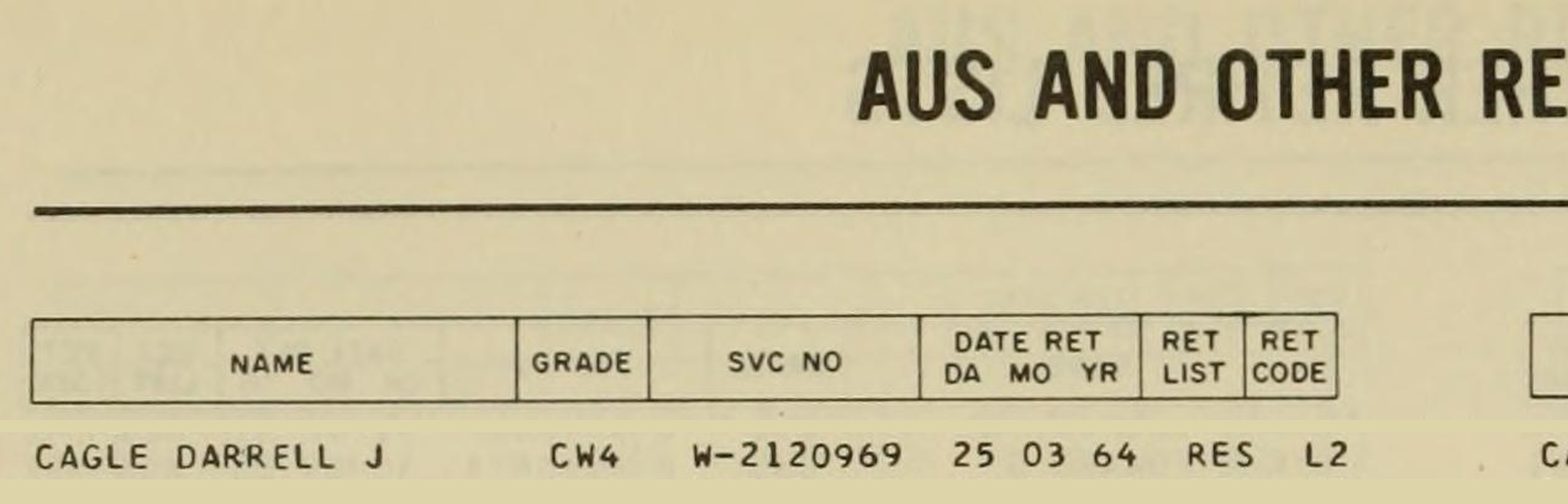
He meant it when he told his company he intended to stay in. In June 1957 Army Times lists him among 216 chief warrant officers recommended for promotion from W-3 to W-4, the highest warrant grade of the day. His active service ends on 24 March 1959, eighteen years and five months after he enlisted at Dallas. The Official Army Register's retired list enters him under his own number: “Cagle Darrell J · CWO · W2120969 · 25 Mar 59,” with the code for the Temporary Disability Retired List. The 1966 Register carries him as CW4, retired for disability, dated 25 March 1964, five years to the day later. His obituary gives the same final grade, chief warrant officer four.

The obituary gives his service as 1943 to 1959. 1943 is the year he became a warrant officer. His enlistment record, the Veterans Administration and his own company's history all date his entry to 1940. Newly discovered.
scanned record
Official Army Register, 1960, AUS and Other Retired Lists, page 79: Cagle Darrell J, CWO, W2120969, 25 Mar 59, Reserve, code L1. The yellow is ours — it marks his name and service number on the sheet.
scanned record
Official Army Register, 1966: Cagle Darrell J, CW4, W-2120969, 25 03 64, code L2. The yellow is ours — it marks his name and service number on the sheet.
scanned record
Army Times, 1 June 1957: “Cagle, Darrell J.” in the list recommended for promotion from W-3 to W-4. The yellow is ours — it marks his name and service number on the sheet.
Confirmed — Record
July 4, 2003

Died at Retsil, aged 91

Darrell Jefferson Cagle died on Independence Day 2003 at the Washington Veterans Home at Retsil, on the bluff above Puget Sound at Port Orchard, some thirty miles north of Fort Lewis, where he had been a staff sergeant of the 125th sixty-one years earlier. He is buried in the home's cemetery, Section 112, Lot 07-C, under a government headstone that reads CWO · US ARMY · WORLD WAR II · KOREA.

His notice in The Sun of Bremerton records that he left the Army as a chief warrant officer four and went on to sell heavy machinery. It lists his son Norman, his daughters Dianne Hogan and Margaret Eddy, his brother Paul, four grandchildren Colleen, Loren, Mark and David, and eleven great-grandchildren. His wife Marcia had died in 1992.
Source: Obituary, The Sun (Bremerton, Washington), Friday 11 July 2003, page A5; Find A Grave memorial #37497186; U.S. Department of Veterans Affairs, Veterans Legacy Memorial; VA BIRLS death file